






 8VTI
8VTI
Latrophilin-3 (ADGRL3) HormR and GAIN domains in the context of the holoreceptor
Summary for 8VTI
| Entry DOI | 10.2210/pdb8vti/pdb |
| EMDB information | 43523 |
| Descriptor | Isoform 4 of Adhesion G protein-coupled receptor L3, sAB Light Chain, sAB Heavy Chain, ... (6 entities in total) |
| Functional Keywords | adhesion gpcr, gain domain, cell-cell adhesion, synapse, signaling protein |
| Biological source | Homo sapiens (human) More |
| Total number of polymer chains | 4 |
| Total formula weight | 126839.64 |
| Authors | Kordon, S.P.,Bandekar, S.J.,Arac, D. (deposition date: 2024-01-26, release date: 2024-12-11, Last modification date: 2025-05-21) |
| Primary citation | Kordon, S.P.,Cechova, K.,Bandekar, S.J.,Leon, K.,Dutka, P.,Siffer, G.,Kossiakoff, A.A.,Vafabakhsh, R.,Arac, D. Conformational coupling between extracellular and transmembrane domains modulates holo-adhesion GPCR function. Nat Commun, 15:10545-10545, 2024 Cited by PubMed Abstract: Adhesion G Protein-Coupled Receptors (aGPCRs) are key cell-adhesion molecules involved in numerous physiological functions. aGPCRs have large multi-domain extracellular regions (ECRs) containing a conserved GAIN domain that precedes their seven-pass transmembrane domain (7TM). Ligand binding and mechanical force applied on the ECR regulate receptor function. However, how the ECR communicates with the 7TM remains elusive, because the relative orientation and dynamics of the ECR and 7TM within a holoreceptor is unclear. Here, we describe the cryo-EM reconstruction of an aGPCR, Latrophilin3/ADGRL3, and reveal that the GAIN domain adopts a parallel orientation to the transmembrane region and has constrained movement. Single-molecule FRET experiments unveil three slow-exchanging FRET states of the ECR relative to the transmembrane region within the holoreceptor. GAIN-targeted antibodies, and cancer-associated mutations at the GAIN-7TM interface, alter FRET states, cryo-EM conformations, and receptor signaling. Altogether, this data demonstrates conformational and functional coupling between the ECR and 7TM, suggesting an ECR-mediated mechanism for aGPCR activation. PubMed: 39627215DOI: 10.1038/s41467-024-54836-4 PDB entries with the same primary citation |
| Experimental method | ELECTRON MICROSCOPY (3.9 Å) |
Structure validation
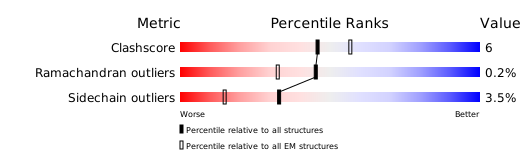
Download full validation report


