






 8UV4
8UV4
M. tuberculosis CTP synthase filament bound to substrates
Summary for 8UV4
| Entry DOI | 10.2210/pdb8uv4/pdb |
| EMDB information | 42605 |
| Descriptor | CTP synthase, ADENOSINE-5'-DIPHOSPHATE, [[(2~{R},3~{S},4~{R},5~{R})-3,4-bis(oxidanyl)-5-(2-oxidanyl-4-phosphonooxy-pyrimidin-1-yl)oxolan-2-yl]methoxy-oxidanyl-phosphoryl] phosphono hydrogen phosphate, ... (4 entities in total) |
| Functional Keywords | metabolic enzyme, filament, ligase |
| Biological source | Mycobacterium tuberculosis |
| Total number of polymer chains | 12 |
| Total formula weight | 787004.84 |
| Authors | Lynch, E.M.,Kollman, J.M. (deposition date: 2023-11-02, release date: 2025-07-02, Last modification date: 2026-01-14) |
| Primary citation | Lynch, E.M.,Lu, Y.,Park, J.H.,Shao, L.,Kollman, J.M.,Rego, E.H. Evolutionarily divergent Mycobacterium tuberculosis CTP synthase filaments are under selective pressure. Nat Commun, 16:5993-5993, 2025 Cited by PubMed Abstract: The final and rate-limiting enzyme in pyrimidine biosynthesis, cytidine triphosphate synthase (CTPS), is essential for the viability of Mycobacterium tuberculosis and other mycobacteria. Its product, cytidine triphosphate (CTP), is critical for RNA, DNA, lipid and cell wall synthesis, and is involved in chromosome segregation. In various organisms across the tree of life, CTPS assembles into higher-order filaments, leading us to hypothesize that M. tuberculosis CTPS (mtCTPS) also forms higher-order structures. Here, we show that mtCTPS does assemble into filaments but with an unusual architecture not seen in other organisms. Through a combination of structural, biochemical, and cellular techniques, we show that polymerization stabilizes the active conformation of the enzyme and resists product inhibition, potentially allowing for the highly localized production of CTP within the cell. Indeed, CTPS filaments localize near the CTP-dependent complex needed for chromosome segregation, and cells expressing mutant enzymes unable to polymerize are altered in their ability to robustly form this complex. Intriguingly, mutants that inhibit filament formation are under positive selection in clinical isolates of M. tuberculosis, pointing to a critical role needed to withstand pressures imposed by the host and/or antibiotics. Taken together, our data reveal an unexpected mechanism for the spatially organized production of a critical nucleotide in M. tuberculosis, which may represent a vulnerability of the pathogen that can be exploited with chemotherapy. PubMed: 40593557DOI: 10.1038/s41467-025-60847-6 PDB entries with the same primary citation |
| Experimental method | ELECTRON MICROSCOPY (3.2 Å) |
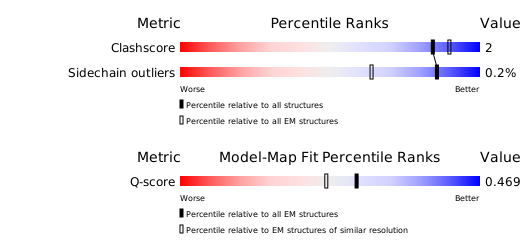
Structure validation
Download full validation report


