






 8SUP
8SUP
Structure of the 48S translation initiation complex assembled on the encephalomyocarditis virus IRES
This is a non-PDB format compatible entry.
Summary for 8SUP
| Entry DOI | 10.2210/pdb8sup/pdb |
| EMDB information | 40774 |
| Descriptor | Eukaryotic translation initiation factor 3 subunit A, EMCV mRNA, Eukaryotic translation initiation factor 1A, X-chromosomal, ... (48 entities in total) |
| Functional Keywords | emcv, ires, cryo-em, 40sic, ribosome |
| Biological source | Oryctolagus cuniculus (rabbit) More |
| Total number of polymer chains | 47 |
| Total formula weight | 1893877.12 |
| Authors | Bhattacharjee, S.,Abaeva, I.S.,Brown, Z.P.,Arhab, Y.,Fallah, H.,Jeevan, J.C.,Hellen, C.U.T.,Frank, J.,Pestova, T.V. (deposition date: 2023-05-12, release date: 2026-03-18, Last modification date: 2026-04-01) |
| Primary citation | Bhattacharjee, S.,Abaeva, I.S.,Brown, Z.P.,Arhab, Y.,Fallah, H.,Hellen, C.U.T.,Frank, J.,Pestova, T.V. The mechanism of ribosomal recruitment during translation initiation on the Type 2 encephalomyocarditis virus IRES. Embo J., 2026 Cited by PubMed Abstract: The encephalomyocarditis virus (EMCV) internal ribosomal entry side (IRES) and other Type 2 IRESs favor translation of the viral genome during infection. The domains H-L of these IRESs specifically interact with the cellular translation initiation factors eIF4G/eIF4A through their essential JK domain. However, the JK domain is not sufficient for IRES activity, which also strictly requires the preceding domain I of unknown function. To identify interactions that drive ribosomal attachment to eIF4G/eIF4A-bound Type 2 IRESs, we determined the cryo-EM structure of 48S initiation complexes formed on the EMCV IRES. The apical cloverleaf of domain I contacts ribosomal proteins uS13 and uS19 via its subdomain Id, whereas the essential GNRA tetraloop in subdomain Ic interacts with the TψC domain of initiator tRNA. The IRES-tRNA interaction also provides a mechanism for release of the IRES after eIF2 is replaced by eIF5B during subunit joining to allow attachment of 60S subunits. Functional assays supported the exceptional role of these interactions for initiation on this IRES. The strong conservation of the apex of domain I amongst Type 2 IRESs suggests that the reported interactions provide a common general mechanism of ribosomal attachment on them all. PubMed: 41851500DOI: 10.1038/s44318-026-00735-x PDB entries with the same primary citation |
| Experimental method | ELECTRON MICROSCOPY (3.1 Å) |
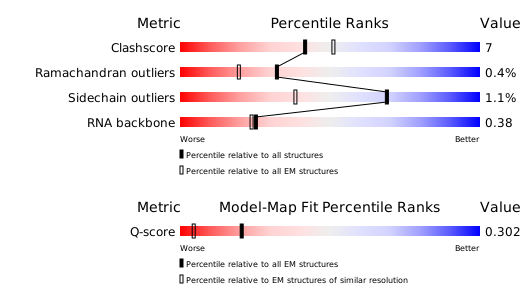
Structure validation
Download full validation report


