






 8RDH
8RDH
Crystal structure of UDP-galactose 4-epimerase from Pyrococcus horikoshii with bound NAD and GDP-L-fucose
Summary for 8RDH
| Entry DOI | 10.2210/pdb8rdh/pdb |
| Descriptor | SDR family NAD(P)-dependent oxidoreductase, NICOTINAMIDE-ADENINE-DINUCLEOTIDE, GUANOSINE-5'-DIPHOSPHATE-BETA-L-FUCOPYRANOSE, ... (4 entities in total) |
| Functional Keywords | udp-galactose 4-epimerase, gale, rossmann fold, gdp-l-fucose, isomerase |
| Biological source | Pyrococcus horikoshii |
| Total number of polymer chains | 2 |
| Total formula weight | 75929.12 |
| Authors | Thunnissen, A.M.W.H.,Alvarez Quispe, C.,Desmet, T. (deposition date: 2023-12-08, release date: 2024-12-18, Last modification date: 2026-07-01) |
| Primary citation | Alvarez Quispe, C.J.,Beerens, K.,Thunnissen, A.W.H.,Biarnes, X.,Planas, A.,Desmet, T. Protein flexibility drives sugar rotation and high substrate promiscuity in a GDP-sugar 4-epimerase. Comput Struct Biotechnol J, 27:2375-2385, 2025 Cited by PubMed Abstract: UDP-galactose 4-epimerases (Gal4Es) catalyze the inversion of the 4-hydroxyl configuration of a sugar moiety from an NDP-sugar through a three-step process: oxidation, rotation and reduction. Despite extensive biochemical and structural studies, the role of protein dynamics on substrate specificity remains poorly understood. The recently identified subgroup of GDP-sugar 4-epimerases, notable for its exceptional substrate promiscuity, provides an intriguing model to investigate the role of dynamics in the Gal4E catalytic mechanism and the unique promiscuity of the subgroup. In this study, we used a multidisciplinary approach to examine the dynamic-function relationships in the representative (Gal4E_1). First, we determined several crystal structures (WT: 1.9-2.4 Å and Y145F: 3.1 Å), providing structural insights of the Gal4E_1 structure bound to GDP-L-fucose in a catalytic conformation. To further explore the enzyme's promiscuity, docking studies were conducted with three substrates, namely GDP-L-Fuc, GDP-Glc and UDP-Glc. Molecular dynamics simulations identified a dynamic hydrogen bond network surrounding the sugar moiety and phosphate groups, revealing four key residues: P80, H182, R83 and N174. These residues interact with either the substrate's sugar moiety (H182 and P80 with C2-OH and C3-OH, resp.) or diphosphate backbone (N174 and R83 with β-/α- and α-phosphate, resp.), which facilitates sugar ring positioning. Protein flexibility then initiates disruption of the hydrogen bonds enabling the required rotation of the intermediate. Site directed mutagenesis of these residues was performed to disrupt the interaction network followed by enzyme activity assays on the three substrates, validating their critical role in the epimerization reaction. These results highlight the pivotal role of protein flexibility in Gal4E_1 promiscuity and establish a framework for dynamic studies across other Gal4E representatives. PubMed: 40529184DOI: 10.1016/j.csbj.2025.05.037 PDB entries with the same primary citation |
| Experimental method | X-RAY DIFFRACTION (2.4 Å) |
Structure validation
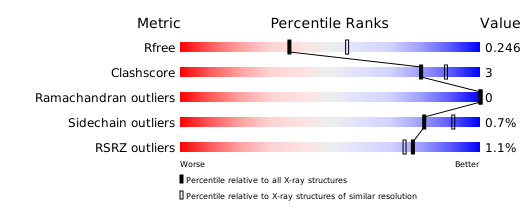
Download full validation report


