






 7POX
7POXSummary for 7POX
| Entry DOI | 10.2210/pdb7pox/pdb |
| Descriptor | Poly [ADP-ribose] polymerase tankyrase-2, N-[3-[5-(5-ethoxypyridin-2-yl)-4-(2-fluorophenyl)-1,2,4-triazol-3-yl]cyclobutyl]pyridine-2-carboxamide (3 entities in total) |
| Functional Keywords | zinc, coordination, enzyme, poly-adp-ribosylation, inhibitor, h2o2, transferase |
| Biological source | Homo sapiens (Human) |
| Total number of polymer chains | 2 |
| Total formula weight | 50573.16 |
| Authors | Sowa, S.T.,Lehtio, L. (deposition date: 2021-09-10, release date: 2022-05-04, Last modification date: 2024-01-31) |
| Primary citation | Sowa, S.T.,Lehtio, L. The zinc-binding motif in tankyrases is required for the structural integrity of the catalytic ADP-ribosyltransferase domain. Open Biology, 12:210365-210365, 2022 Cited by PubMed Abstract: Tankyrases are ADP-ribosylating enzymes that regulate many physiological processes in the cell and are considered promising drug targets for cancer and fibrotic diseases. The catalytic ADP-ribosyltransferase domain of tankyrases contains a unique zinc-binding motif of unknown function. Recently, this motif was suggested to be involved in the catalytic activity of tankyrases. In this work, we set out to study the effect of the zinc-binding motif on the activity, stability and structure of human tankyrases. We generated mutants of human tankyrase (TNKS) 1 and TNKS2, abolishing the zinc-binding capabilities, and characterized the proteins biochemically and biophysically . We further generated a crystal structure of TNKS2, in which the zinc ion was oxidatively removed. Our work shows that the zinc-binding motif in tankyrases is a crucial structural element which is particularly important for the structural integrity of the acceptor site. While mutation of the motif rendered TNKS1 inactive, probably due to introduction of major structural defects, the TNKS2 mutant remained active and displayed an altered activity profile compared to the wild-type. PubMed: 35317661DOI: 10.1098/rsob.210365 PDB entries with the same primary citation |
| Experimental method | X-RAY DIFFRACTION (2.5 Å) |
Structure validation
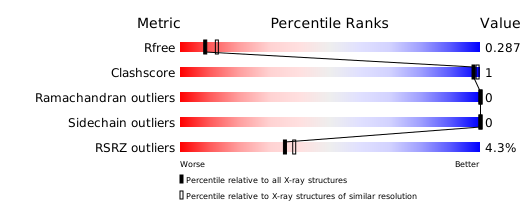
Download full validation report


