






 5NA9
5NA9
The X-ray structure of bovine pancreatic ribonuclease incubated in the presence of an excess of carboplatin (1:10 ratio)
Summary for 5NA9
| Entry DOI | 10.2210/pdb5na9/pdb |
| Descriptor | Ribonuclease pancreatic, carboplatin, CESIUM ION, ... (5 entities in total) |
| Functional Keywords | carboplatin, ribonucleases, protein platination, hydrolase |
| Biological source | Bos taurus (Bovine) |
| Cellular location | Secreted: P61823 |
| Total number of polymer chains | 1 |
| Total formula weight | 14930.27 |
| Authors | Ferraro, G.,Merlino, A. (deposition date: 2017-02-27, release date: 2017-08-16, Last modification date: 2024-10-16) |
| Primary citation | Picone, D.,Donnarumma, F.,Ferraro, G.,Gotte, G.,Fagagnini, A.,Butera, G.,Donadelli, M.,Merlino, A. A comparison study on RNase A oligomerization induced by cisplatin, carboplatin and oxaliplatin. J. Inorg. Biochem., 173:105-112, 2017 Cited by PubMed Abstract: Cisplatin (CDDP) can form interprotein cross-links, leading to the formation of platinated oligomers. A dimer, a trimer and higher oligomers of bovine pancreatic ribonuclease (RNase A) obtained upon reaction with CDDP in 1:10 protein to metal ratio at 37°C have been previously characterized. Here, we verify the ability of carboplatin and oxaliplatin to induce RNase A oligomerization under the same experimental conditions. The amount of formed RNase A oligomers was compared with that obtained in the reaction of the protein with CDDP. Among the three anticancer agents, CDDP is the most reactive and the most effective in inhibiting the ribonucleolytic activity of the protein. Oxaliplatin is the least potent oligomerization agent. Biophysical characterizations of structure and stability of platinated dimers formed in the presence of carboplatin and oxaliplatin suggest that they have a similar thermal stability and are more prone to dissociation than the corresponding dimer obtained with CDDP. Oligomers obtained in the presence of carboplatin are the most active. X-ray structures of the monomeric adducts that RNase A forms with the three drugs provide a rational basis to explain the different effects of the three anticancer agents on enzymatic activity and protein aggregation. Although platinated oligomers of RNase A formed upon reaction with CDDP, carboplatin and oxaliplatin retain a residual ribonuclease activity, they do not show cytotoxic action, suggesting that protein aggregation processes induced by Pt-based drugs can represent a collateral drawback, which affects the functional state of protein targets and reduces the efficacy of Pt-based drug treatment. PubMed: 28511060DOI: 10.1016/j.jinorgbio.2017.05.005 PDB entries with the same primary citation |
| Experimental method | X-RAY DIFFRACTION (2.07 Å) |
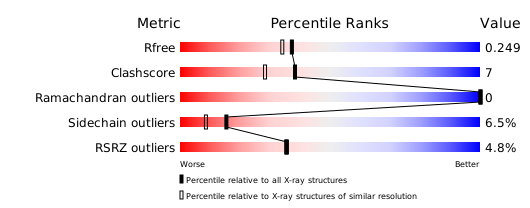
Structure validation
Download full validation report


