






 5D8N
5D8N
Tomato leucine aminopeptidase mutant - K354E
Summary for 5D8N
| Entry DOI | 10.2210/pdb5d8n/pdb |
| Descriptor | Leucine aminopeptidase 1, chloroplastic, CHLORIDE ION, MAGNESIUM ION, ... (6 entities in total) |
| Functional Keywords | hydrolase |
| Biological source | Solanum lycopersicum (Tomato) |
| Total number of polymer chains | 3 |
| Total formula weight | 168384.84 |
| Authors | DuPrez, K.T.,Scranton, M.A.,Walling, L.L.,Fan, L. (deposition date: 2015-08-17, release date: 2016-05-11, Last modification date: 2023-09-27) |
| Primary citation | DuPrez, K.T.,Scranton, M.A.,Walling, L.L.,Fan, L. Structural insights into chaperone-activity enhancement by a K354E mutation in tomato acidic leucine aminopeptidase. Acta Crystallogr D Struct Biol, 72:694-702, 2016 Cited by PubMed Abstract: Tomato plants express acidic leucine aminopeptidase (LAP-A) in response to various environmental stressors. LAP-A not only functions as a peptidase for diverse peptide substrates, but also displays chaperone activity. A K354E mutation has been shown to abolish the peptidase activity but to enhance the chaperone activity of LAP-A. To better understand this moonlighting function of LAP-A, the crystal structure of the K354E mutant was determined at 2.15 Å resolution. The structure reveals that the K354E mutation destabilizes an active-site loop and causes significant rearrangement of active-site residues, leading to loss of the catalytic metal-ion coordination required for the peptidase activity. Although the mutant was crystallized in the same hexameric form as wild-type LAP-A, gel-filtration chromatography revealed an apparent shift from the hexamer to lower-order oligomers for the K354E mutant, showing a mixture of monomers to trimers in solution. In addition, surface-probing assays indicated that the K354E mutant has more accessible hydrophobic areas than wild-type LAP-A. Consistently, computational thermodynamic estimations of the interfaces between LAP-A monomers suggest that increased exposure of hydrophobic surfaces occurs upon hexamer breakdown. These results suggest that the K354E mutation disrupts the active-site loop, which also contributes to the hexameric assembly, and destabilizes the hexamers, resulting in much greater hydrophobic areas accessible for efficient chaperone activity than in the wild-type LAP-A. PubMed: 27139632DOI: 10.1107/S205979831600509X PDB entries with the same primary citation |
| Experimental method | X-RAY DIFFRACTION (2.15 Å) |
Structure validation
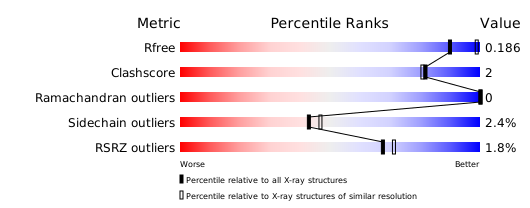
Download full validation report


