






 5CRA
5CRA
Structure of the SdeA DUB Domain
Summary for 5CRA
| Entry DOI | 10.2210/pdb5cra/pdb |
| Related | 5CRB 5CRC |
| Descriptor | SdeA, Polyubiquitin-B, SULFATE ION, ... (5 entities in total) |
| Functional Keywords | deubiquitinase, legionella, hydrolase |
| Biological source | Legionella pneumophila More |
| Total number of polymer chains | 4 |
| Total formula weight | 60091.65 |
| Authors | Sheedlo, M.J.,Qiu, J.,Luo, Z.Q.,Das, C. (deposition date: 2015-07-22, release date: 2015-11-25, Last modification date: 2023-11-15) |
| Primary citation | Sheedlo, M.J.,Qiu, J.,Tan, Y.,Paul, L.N.,Luo, Z.Q.,Das, C. Structural basis of substrate recognition by a bacterial deubiquitinase important for dynamics of phagosome ubiquitination. Proc.Natl.Acad.Sci.USA, 112:15090-15095, 2015 Cited by PubMed Abstract: Manipulation of the host's ubiquitin network is emerging as an important strategy for counteracting and repurposing the posttranslational modification machineries of the host by pathogens. Ubiquitin E3 ligases encoded by infectious agents are well known, as are a variety of viral deubiquitinases (DUBs). Bacterial DUBs have been discovered, but little is known about the structure and mechanism underlying their ubiquitin recognition. In this report, we found that members of the Legionella pneumophila SidE effector family harbor a DUB module important for ubiquitin dynamics on the bacterial phagosome. Structural analysis of this domain alone and in complex with ubiquitin vinyl methyl ester (Ub-VME) reveals unique molecular contacts used in ubiquitin recognition. Instead of relying on the Ile44 patch of ubiquitin, as commonly used in eukaryotic counterparts, the SdeADub module engages Gln40 of ubiquitin. The architecture of the active-site cleft presents an open arrangement with conformational plasticity, permitting deubiquitination of three of the most abundant polyubiquitin chains, with a distinct preference for Lys63 linkages. We have shown that this preference enables efficient removal of Lys63 linkages from the phagosomal surface. Remarkably, the structure reveals by far the most parsimonious use of molecular contacts to achieve deubiquitination, with less than 1,000 Å(2) of accessible surface area buried upon complex formation with ubiquitin. This type of molecular recognition appears to enable dual specificity toward ubiquitin and the ubiquitin-like modifier NEDD8. PubMed: 26598703DOI: 10.1073/pnas.1514568112 PDB entries with the same primary citation |
| Experimental method | X-RAY DIFFRACTION (2.64 Å) |
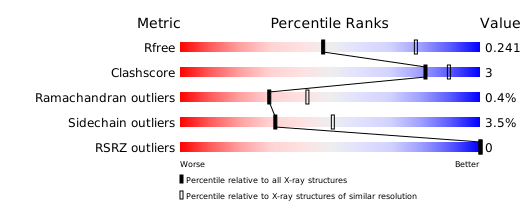
Structure validation
Download full validation report


