






 4TXO
4TXO
Crystal structure of the mixed disulfide complex of thioredoxin-like TlpAs(C110S) and copper chaperone ScoIs(C74S)
Summary for 4TXO
| Entry DOI | 10.2210/pdb4txo/pdb |
| Related | 4TXV |
| Descriptor | Thiol:disulfide interchange protein TlpA, Blr1131 protein, THIOCYANATE ION, ... (6 entities in total) |
| Functional Keywords | mixed disulfide, soluble domain of membrane protein, thioredoxin fold, copper protein, protein binding, oxidodreductase/copper binding protein, oxidodreductase-copper binding protein complex |
| Biological source | Bradyrhizobium diazoefficiens USDA 110 More |
| Cellular location | Cell membrane; Single-pass type II membrane protein; Periplasmic side: P43221 |
| Total number of polymer chains | 8 |
| Total formula weight | 155686.20 |
| Authors | Scharer, M.A.,Abicht, H.K.,Glockshuber, R.,Hennecke, H. (deposition date: 2014-07-04, release date: 2014-10-01, Last modification date: 2024-11-13) |
| Primary citation | Abicht, H.K.,Scharer, M.A.,Quade, N.,Ledermann, R.,Mohorko, E.,Capitani, G.,Hennecke, H.,Glockshuber, R. How Periplasmic Thioredoxin TlpA Reduces Bacterial Copper Chaperone ScoI and Cytochrome Oxidase Subunit II (CoxB) Prior to Metallation. J.Biol.Chem., 289:32431-32444, 2014 Cited by PubMed Abstract: Two critical cysteine residues in the copper-A site (Cu(A)) on subunit II (CoxB) of bacterial cytochrome c oxidase lie on the periplasmic side of the cytoplasmic membrane. As the periplasm is an oxidizing environment as compared with the reducing cytoplasm, the prediction was that a disulfide bond formed between these cysteines must be eliminated by reduction prior to copper insertion. We show here that a periplasmic thioredoxin (TlpA) acts as a specific reductant not only for the Cu(2+) transfer chaperone ScoI but also for CoxB. The dual role of TlpA was documented best with high-resolution crystal structures of the kinetically trapped TlpA-ScoI and TlpA-CoxB mixed disulfide intermediates. They uncovered surprisingly disparate contact sites on TlpA for each of the two protein substrates. The equilibrium of CoxB reduction by TlpA revealed a thermodynamically favorable reaction, with a less negative redox potential of CoxB (E'0 = -231 mV) as compared with that of TlpA (E'0 = -256 mV). The reduction of CoxB by TlpA via disulfide exchange proved to be very fast, with a rate constant of 8.4 × 10(4) M(-1) s(-1) that is similar to that found previously for ScoI reduction. Hence, TlpA is a physiologically relevant reductase for both ScoI and CoxB. Although the requirement of ScoI for assembly of the Cu(A)-CoxB complex may be bypassed in vivo by high environmental Cu(2+) concentrations, TlpA is essential in this process because only reduced CoxB can bind copper ions. PubMed: 25274631DOI: 10.1074/jbc.M114.607127 PDB entries with the same primary citation |
| Experimental method | X-RAY DIFFRACTION (2.2 Å) |
Structure validation
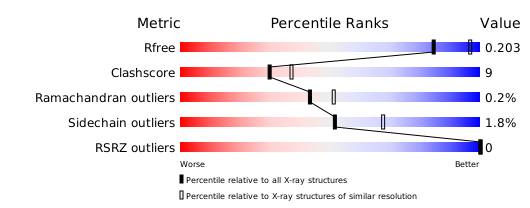
Download full validation report


