






 4DXX
4DXX
TGT K52M mutant crystallized at pH 8.5
Summary for 4DXX
| Entry DOI | 10.2210/pdb4dxx/pdb |
| Related | 1PUD 3HFY 3UNT 3UVI 4DY1 |
| Descriptor | Queuine tRNA-ribosyltransferase, ZINC ION, GLYCEROL, ... (5 entities in total) |
| Functional Keywords | functional dimer, dimer interface, transferase, guanine exchange enzyme, zinc binding, guanine binding, trna binding |
| Biological source | Zymomonas mobilis |
| Total number of polymer chains | 1 |
| Total formula weight | 43319.62 |
| Authors | Jakobi, S.,Ritschel, T.,Heine, A.,Klebe, G. (deposition date: 2012-02-28, release date: 2013-03-27, Last modification date: 2023-09-13) |
| Primary citation | Jakobi, S.,Nguyen, T.X.,Debaene, F.,Metz, A.,Sanglier-Cianferani, S.,Reuter, K.,Klebe, G. Hot-spot analysis to dissect the functional protein-protein interface of a tRNA-modifying enzyme. Proteins, 82:2713-2732, 2014 Cited by PubMed Abstract: Interference with protein-protein interactions of interfaces larger than 1500 Ų by small drug-like molecules is notoriously difficult, particularly if targeting homodimers. The tRNA modifying enzyme Tgt is only functionally active as a homodimer. Thus, blocking Tgt dimerization is a promising strategy for drug therapy as this protein is key to the development of Shigellosis. Our goal was to identify hot-spot residues which, upon mutation, result in a predominantly monomeric state of Tgt. The detailed understanding of the spatial location and stability contribution of the individual interaction hot-spot residues and the plasticity of motifs involved in the interface formation is a crucial prerequisite for the rational identification of drug-like inhibitors addressing the respective dimerization interface. Using computational analyses, we identified hot-spot residues that contribute particularly to dimer stability: a cluster of hydrophobic and aromatic residues as well as several salt bridges. This in silico prediction led to the identification of a promising double mutant, which was validated experimentally. Native nano-ESI mass spectrometry showed that the dimerization of the suggested mutant is largely prevented resulting in a predominantly monomeric state. Crystal structure analysis and enzyme kinetics of the mutant variant further support the evidence for enhanced monomerization and provide first insights into the structural consequences of the dimer destabilization. PubMed: 24975703DOI: 10.1002/prot.24637 PDB entries with the same primary citation |
| Experimental method | X-RAY DIFFRACTION (1.66 Å) |
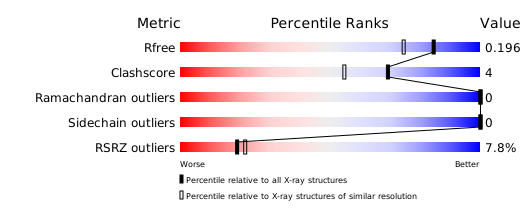
Structure validation
Download full validation report


