






 2F7T
2F7T
Crystal structure of the catalytic domain of Mos1 mariner transposase
Summary for 2F7T
| Entry DOI | 10.2210/pdb2f7t/pdb |
| Descriptor | Mos1 transposase, MAGNESIUM ION (3 entities in total) |
| Functional Keywords | rnase-h like fold, ddd motif, dna binding protein |
| Biological source | Drosophila mauritiana |
| Total number of polymer chains | 1 |
| Total formula weight | 27201.20 |
| Authors | Richardson, J.M.,Dawson, A.,Taylor, P.,Finnegan, D.J.,Walkinshaw, M.D. (deposition date: 2005-12-01, release date: 2006-03-28, Last modification date: 2024-02-14) |
| Primary citation | Richardson, J.M.,Dawson, A.,O'hagan, N.,Taylor, P.,Finnegan, D.J.,Walkinshaw, M.D. Mechanism of Mos1 transposition: insights from structural analysis Embo J., 25:1324-1334, 2006 Cited by PubMed Abstract: We present the crystal structure of the catalytic domain of Mos1 transposase, a member of the Tc1/mariner family of transposases. The structure comprises an RNase H-like core, bringing together an aspartic acid triad to form the active site, capped by N- and C-terminal alpha-helices. We have solved structures with either one Mg2+ or two Mn2+ ions in the active site, consistent with a two-metal mechanism for catalysis. The lack of hairpin-stabilizing structural motifs is consistent with the absence of a hairpin intermediate in Mos1 excision. We have built a model for the DNA-binding domain of Mos1 transposase, based on the structure of the bipartite DNA-binding domain of Tc3 transposase. Combining this with the crystal structure of the catalytic domain provides a model for the paired-end complex formed between a dimer of Mos1 transposase and inverted repeat DNA. The implications for the mechanisms of first and second strand cleavage are discussed. PubMed: 16511570DOI: 10.1038/sj.emboj.7601018 PDB entries with the same primary citation |
| Experimental method | X-RAY DIFFRACTION (2.25 Å) |
Structure validation
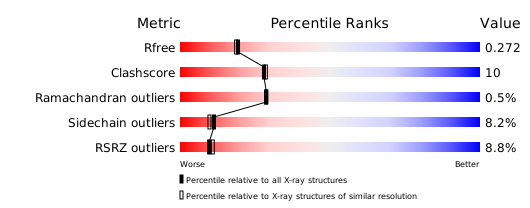
Download full validation report


