






 12UP
12UP
BCL11B ZF2-3 in Complex with a DNA Sequence Observed in the Human Globin Locus Containing Motif TGGCCA (Oligo 4-2)
Summary for 12UP
| Entry DOI | 10.2210/pdb12up/pdb |
| Descriptor | B-cell lymphoma/leukemia 11B, Strand Top, Strand Bottom, ... (6 entities in total) |
| Functional Keywords | transcription factor, dna binding, transcription, transcription-dna complex, globin locus, dna binding protein, dna binding protein-dna complex, dna binding protein/dna |
| Biological source | Homo sapiens (human) More |
| Total number of polymer chains | 6 |
| Total formula weight | 31248.94 |
| Authors | |
| Primary citation | Lee, J.,Zhou, J.,Horton, J.R.,Yu, M.,Muoghalu, M.D.,Khan, F.A.,Zhang, X.,Huang, Y.,Blumenthal, R.M.,Zhang, X.,Cheng, X. Bipartite DNA binding domain of transcription factor BCL11B binds clustered short DNA sequence motifs. Biorxiv, 2026 Cited by PubMed Abstract: B-cell leukemia/lymphoma 11B (BCL11B), despite its name, is a key regulator of T-cell development, specification, and T-cell malignancies. BCL11B contains a bipartite DNA binding domain composed of two C2H2 zinc finger arrays: low-affinity ZF2-3 and high affinity ZF4-6. These arrays function as homotypic modules that recognize similar six-nucleotide motifs, TG(N)CC(C/T/A), as seven of the eight DNA base-contacting residues are conserved between them. The most conserved interactions involve GG dinucleotides, contacted by arginine and lysine residues at key base-interacting positions in ZF3 and ZF5. The two ZF arrays are connected by a long ~300-residue linker that provides flexibility in how the arrays engage DNA, allowing ZF2-3 and ZF4-6 binding to the same or opposite strands with variable orientation, spacing and positioning along the DNA. This extended linker is enriched in serine/threonine, acidic residues (aspartate/glutamate), and structural residues (glycine/proline), providing additional layers of transcriptional regulation possibly through post-translational modification, electrostatic modulation, and/or condensate formation. We also examined six missense mutations in base-interacting residues, that are associated with neurodevelopmental disorders. Substitutions replacing bulky, positively charged arginine or lysine with smaller or hydrophobic residues likely reduce DNA-binding affinity and/or specificity, whereas substitutions between asparagine and lysine may alter base recognition preferences. PubMed: 42232506DOI: 10.64898/2026.05.01.721897 PDB entries with the same primary citation |
| Experimental method | X-RAY DIFFRACTION (2.83 Å) |
Structure validation
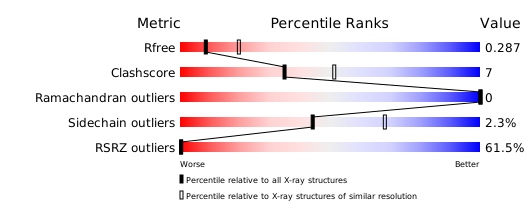
Download full validation report


