






 12KH
12KH
The Condensation Domain from Coprococcus Eutactus, OaaC
Summary for 12KH
| Entry DOI | 10.2210/pdb12kh/pdb |
| Descriptor | Condensation Domain Protein, GLYCEROL, DI(HYDROXYETHYL)ETHER, ... (4 entities in total) |
| Functional Keywords | condensation, nrps, fatty acid, small molecule amine, biosynthetic protein |
| Biological source | Coprococcus eutactus ATCC 27759 |
| Total number of polymer chains | 2 |
| Total formula weight | 110757.62 |
| Authors | Singh, J.,Grant, T.D.,Gulick, A.M. (deposition date: 2026-04-09, release date: 2026-04-29, Last modification date: 2026-07-08) |
| Primary citation | Singh, J.,Grant, T.D.,Gulick, A.M. Structure of a stand-alone homodimeric nonribosomal peptide synthetase condensation domain reveals occlusion of the canonical carrier-protein interface. J.Biol.Chem., 302:113208-113208, 2026 Cited by PubMed Abstract: Fatty acid amides (FAAs) produced by gut-resident bacteria act as potent modulators of host G-protein coupled receptor signaling, yet the enzymatic mechanisms underlying their biosynthesis remain poorly understood. In many bacteria from the gut microbiome, including Coprococcus eutactus, FAA production is mediated by a nonribosomal peptide synthetase (NRPS)-like pathway that includes OaaC, a free-standing condensation domain that catalyzes amide bond formation between acyl carrier protein (ACP) tethered fatty acids and small-molecule amine acceptors. Here, we combine structural, biophysical, biochemical, and evolutionary analyses to interrogate the molecular basis of OaaC function. Solution scattering and X-ray crystallography reveal that OaaC adopts an atypical homodimeric architecture that occludes the canonical ACP-binding surface and donor access pathways. Mass photometry demonstrates that this homodimer is stable in the absence of substrates and is insensitive to free fatty acids, free amines, and apo-ACP. In contrast, holo or acyl-loaded OaaACP selectively destabilizes the homodimer forming the OaaC-OaaACP complex population. LC-MS reconstitution assays confirm that OaaC catalyzes fatty acid amide formation in vitro and can utilize acyl donors spanning multiple chain lengths and saturation states. Phylogenetic and sequence analyses place FAA-associated condensation domains in a distinct clade most closely related to starter condensation domains and reveal a conserved noncanonical active site motif that differentiates them from PCP-dependent NRPS condensation domains. Together, these findings support a model in which OaaC activity is regulated through substrate-dependent modulation of oligomeric state, providing a model framework for understanding FAA biosynthesis in gut microbes and expanding the known functional diversity of NRPS condensation domains. PubMed: 42208893DOI: 10.1016/j.jbc.2026.113208 PDB entries with the same primary citation |
| Experimental method | X-RAY DIFFRACTION (2.15 Å) |
Structure validation
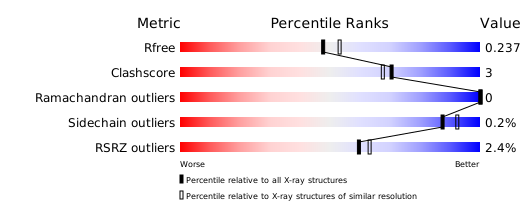
Download full validation report


