






 11QF
11QF
I-PnoMI with solubilizing mutations
Summary for 11QF
| Entry DOI | 10.2210/pdb11qf/pdb |
| Descriptor | I-PnoMI, DNA (26-MER), CALCIUM ION, ... (5 entities in total) |
| Functional Keywords | homing endonuclease, enzyme, dna, mutation, dna binding protein |
| Biological source | Phaeosphaeria nodorum More |
| Total number of polymer chains | 6 |
| Total formula weight | 101055.39 |
| Authors | Doyle, L.,Stoddard, B. (deposition date: 2026-03-10, release date: 2026-03-25, Last modification date: 2026-07-08) |
| Primary citation | Esler, M.A.,Werther, R.,Doyle, L.A.,Ubilla-Rodriguez, N.C.,Schwensen, J.S.,Hallinan, J.P.,Lambert, A.R.,Young, J.C.,Silverstein, M.,Stoddard, B.L. Caveat emptor: predicting and modeling protein-DNA recognition and binding via machine-learning computational approaches. Nucleic Acids Res., 54:-, 2026 Cited by PubMed Abstract: The recent development of AI-based predictive tools, such as AlphaFold3, for the prediction of the structures of biological molecules and their complexes has transformed modern molecular and cellular biology. While it displays exceptional accuracy in the modeling of folded protein domains and subunits, as well as larger protein-protein complexes and assemblages, AlphaFold3's performance in predicting the details of protein-DNA (or more broadly, protein-nucleic acid) contacts and complexes is less well established. Here we summarize the recent development and performance of tools intended to predict, model, and/or design protein:DNA recognition and contacts, and then demonstrate (using a well-defined system that offers a minimal "degree of difficulty") the issues that often surround the use of a resource such as AlphaFold3 for predicting protein:DNA interactions. Beyond providing a cautionary tale for casual users, we note that the incorporation of hybrid models of protein-DNA complexes (in which computationally predicted models are docked into low-resolution CryoEM density maps with little further refinement or quality control) into future training sets may lead to an ongoing and inappropriate learning cycle that further encourages such tools to generate new, equally inaccurate models of protein-DNA complexes. PubMed: 42345194DOI: 10.1093/nar/gkag608 PDB entries with the same primary citation |
| Experimental method | X-RAY DIFFRACTION (1.87 Å) |
Structure validation
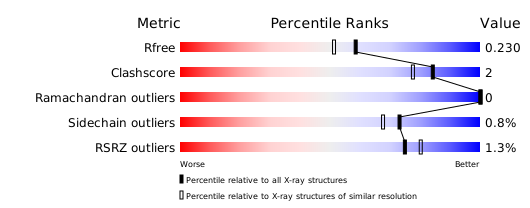
Download full validation report


