






 10ID
10ID
Membrane-bound, reversed VP5* trimer (rotavirus spike protein)
Summary for 10ID
| Entry DOI | 10.2210/pdb10id/pdb |
| EMDB information | 75186 |
| Descriptor | Outer capsid protein VP4 (1 entity in total) |
| Functional Keywords | rotavirus, non-enveloped virus, virus, viral entry, tomography, viral protein |
| Biological source | Simian rotavirus A strain RRV |
| Total number of polymer chains | 3 |
| Total formula weight | 259966.76 |
| Authors | de Sautu, M.,Leistner, C.,Kirchhausen, T.,Jenni, S.,Harrison, S.C. (deposition date: 2026-01-21, release date: 2026-02-04, Last modification date: 2026-09-23) |
| Primary citation | de Sautu, M.,Leistner, C.,Kirchhausen, T.,Jenni, S.,Harrison, S.C. Mechanism of membrane perforation in rotavirus cell entry. Science, 393:1128-1133, 2026 Cited by PubMed Abstract: Cell entry of nonenveloped animal viruses requires translocation of a macromolecular assembly across a cellular membrane. Double-stranded RNA viruses introduce into the target cell an inner capsid particle that does not uncoat further. Instead, it extrudes capped viral mRNA by virtue of polymerase and capping activities within it. As described here, we used cryogenic electron tomography to visualize the full course of rhesus rotavirus entry, from cell attachment and virion uptake to release of the subviral particle. The cryo-tomograms and subtomogram averaging of classified subparticles link high-resolution structures of the virion and its components with time series from live-cell fluorescence microscopy. We outline the mechanism of each step in the entry process, including the membrane perforation step that transfers a subviral particle into the cytosol. PubMed: 42721255DOI: 10.1126/science.aeg4851 PDB entries with the same primary citation |
| Experimental method | ELECTRON MICROSCOPY (9.54 Å) |
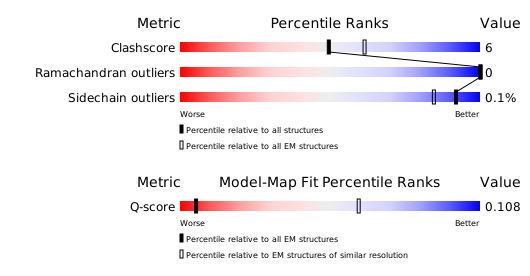
Structure validation
Download full validation report


