 Movie
Movie Controller


+ Open data

- Basic information
| Entry | Database: PDB / ID: 6ro4 | |||||||||||||||
|---|---|---|---|---|---|---|---|---|---|---|---|---|---|---|---|---|
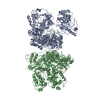
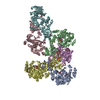
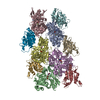
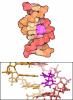
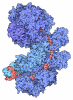
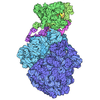
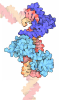
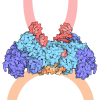
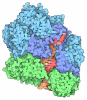
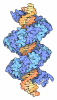
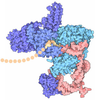
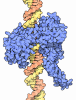
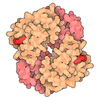
| Title | Structure of the core TFIIH-XPA-DNA complex | |||||||||||||||
 Components Components |
| |||||||||||||||
 Keywords Keywords | TRANSLOCASE / Complex / Helicase / DNA repair | |||||||||||||||
| Function / homology |  Function and homology information Function and homology informationnucleotide-excision repair factor 1 complex / nucleotide-excision repair involved in interstrand cross-link repair / nucleotide-excision repair, DNA damage recognition / MMXD complex / core TFIIH complex portion of holo TFIIH complex / Cytosolic iron-sulfur cluster assembly / positive regulation of mitotic recombination / nucleotide-excision repair factor 3 complex / hair cell differentiation / nucleotide-excision repair, preincision complex assembly ...nucleotide-excision repair factor 1 complex / nucleotide-excision repair involved in interstrand cross-link repair / nucleotide-excision repair, DNA damage recognition / MMXD complex / core TFIIH complex portion of holo TFIIH complex / Cytosolic iron-sulfur cluster assembly / positive regulation of mitotic recombination / nucleotide-excision repair factor 3 complex / hair cell differentiation / nucleotide-excision repair, preincision complex assembly / UV protection / CAK-ERCC2 complex / transcription factor TFIIH core complex / transcription factor TFIIH holo complex / G protein-coupled receptor internalization / DNA 5'-3' helicase / transcription preinitiation complex / RNA Polymerase I Transcription Termination / embryonic organ development / UV-damage excision repair / transcription factor TFIID complex / RNA polymerase II general transcription initiation factor activity / RNA Pol II CTD phosphorylation and interaction with CE during HIV infection / RNA Pol II CTD phosphorylation and interaction with CE / regulation of mitotic cell cycle phase transition / Formation of the Early Elongation Complex / Formation of the HIV-1 Early Elongation Complex / mRNA Capping / HIV Transcription Initiation / RNA Polymerase II HIV Promoter Escape / Transcription of the HIV genome / RNA Polymerase II Promoter Escape / RNA Polymerase II Transcription Pre-Initiation And Promoter Opening / RNA Polymerase II Transcription Initiation / RNA Polymerase II Transcription Initiation And Promoter Clearance / ATPase activator activity / 5'-3' DNA helicase activity / DNA topological change / RNA Polymerase I Transcription Initiation / response to UV / DNA 3'-5' helicase / protein localization to nucleus / Tat-mediated elongation of the HIV-1 transcript / 3'-5' DNA helicase activity / Formation of HIV-1 elongation complex containing HIV-1 Tat / Formation of HIV elongation complex in the absence of HIV Tat / RNA Polymerase II Transcription Elongation / Formation of RNA Pol II elongation complex / RNA Polymerase II Pre-transcription Events / transcription-coupled nucleotide-excision repair / chromosome segregation / TP53 Regulates Transcription of DNA Repair Genes / RNA Polymerase I Promoter Escape / promoter-specific chromatin binding / transcription initiation at RNA polymerase II promoter / nucleotide-excision repair / transcription elongation by RNA polymerase II / base-excision repair / NoRC negatively regulates rRNA expression / transcription by RNA polymerase II / spindle / intracellular protein localization / Dual Incision in GG-NER / Transcription-Coupled Nucleotide Excision Repair (TC-NER) / Formation of TC-NER Pre-Incision Complex / Formation of Incision Complex in GG-NER / sequence-specific double-stranded DNA binding / 4 iron, 4 sulfur cluster binding / Dual incision in TC-NER / Gap-filling DNA repair synthesis and ligation in TC-NER / response to oxidative stress / double-stranded DNA binding / damaged DNA binding / nuclear body / DNA helicase activity / nuclear speck / protein-macromolecule adaptor activity / apoptotic process / positive regulation of apoptotic process / DNA repair / protein domain specific binding / regulation of transcription by RNA polymerase II / nucleolus / regulation of DNA-templated transcription / protein homodimerization activity / ATP hydrolysis activity / metal ion binding / DNA binding / zinc ion binding / nucleoplasm / ATP binding / nucleus / cytoplasm Similarity search - Function | |||||||||||||||
| Biological species |  Homo sapiens (human) Homo sapiens (human) | |||||||||||||||
| Method | ELECTRON MICROSCOPY / single particle reconstruction / cryo EM / Resolution: 3.5 Å | |||||||||||||||
 Authors Authors | Kokic, G. / Chernev, A. / Tegunov, D. / Dienemann, C. / Urlaub, H. / Cramer, P. | |||||||||||||||
| Funding support |  Germany, 4items Germany, 4items
| |||||||||||||||
 Citation Citation | Journal: Nat Commun / Year: 2019 Title: Structural basis of TFIIH activation for nucleotide excision repair. Authors: Goran Kokic / Aleksandar Chernev / Dimitry Tegunov / Christian Dienemann / Henning Urlaub / Patrick Cramer / Abstract: Nucleotide excision repair (NER) is the major DNA repair pathway that removes UV-induced and bulky DNA lesions. There is currently no structure of NER intermediates, which form around the large ...Nucleotide excision repair (NER) is the major DNA repair pathway that removes UV-induced and bulky DNA lesions. There is currently no structure of NER intermediates, which form around the large multisubunit transcription factor IIH (TFIIH). Here we report the cryo-EM structure of an NER intermediate containing TFIIH and the NER factor XPA. Compared to its transcription conformation, the TFIIH structure is rearranged such that its ATPase subunits XPB and XPD bind double- and single-stranded DNA, consistent with their translocase and helicase activities, respectively. XPA releases the inhibitory kinase module of TFIIH, displaces a 'plug' element from the DNA-binding pore in XPD, and together with the NER factor XPG stimulates XPD activity. Our results explain how TFIIH is switched from a transcription to a repair factor, and provide the basis for a mechanistic analysis of the NER pathway. | |||||||||||||||
| History |
|
- Structure visualization
| Movie |
Movie viewer |
|---|---|
| Structure viewer | Molecule: MolmilJmol/JSmol |
- Downloads & links
-Download
| PDBx/mmCIF format | 6ro4.cif.gz | 465.1 KB | Display | PDBx/mmCIF format |
|---|---|---|---|---|
| PDB format | pdb6ro4.ent.gz | 363.2 KB | Display | PDB format |
| PDBx/mmJSON format | 6ro4.json.gz | Tree view | PDBx/mmJSON format | |
| Others |  Other downloads Other downloads |
-Validation report
| Arichive directory | https://data.pdbj.org/pub/pdb/validation_reports/ro/6ro4ftp://data.pdbj.org/pub/pdb/validation_reports/ro/6ro4 | HTTPS FTP |
|---|
-Related structure data
| Related structure data | 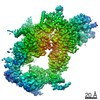 4970MC M: map data used to model this data C: citing same article ( |
|---|---|
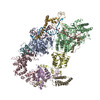
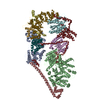
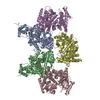
| Similar structure data |
-Links
 PDBj
PDBj


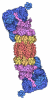
- Assembly
| Deposited unit | 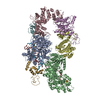
|
|---|---|
| 1 |
|
-Components
-DNA chain , 2 types, 2 molecules JK
| #1: DNA chain | Mass: 15036.663 Da / Num. of mol.: 1 / Source method: obtained synthetically / Source: (synth.) Homo sapiens (human) |
|---|---|
| #2: DNA chain | Mass: 15075.698 Da / Num. of mol.: 1 / Source method: obtained synthetically / Source: (synth.) Homo sapiens (human) |
-Protein , 3 types, 3 molecules ABG
| #3: Protein | Mass: 89404.734 Da / Num. of mol.: 1 Source method: isolated from a genetically manipulated source Source: (gene. exp.) Homo sapiens (human) / Gene: ERCC3, XPB, XPBC / Production host:  Trichoplusia ni (cabbage looper) / References: UniProt: P19447, DNA helicase Trichoplusia ni (cabbage looper) / References: UniProt: P19447, DNA helicase |
|---|---|
| #5: Protein | Mass: 87021.078 Da / Num. of mol.: 1 Source method: isolated from a genetically manipulated source Source: (gene. exp.) Homo sapiens (human) / Gene: ERCC2, XPD, XPDC / Production host: Trichoplusia ni (cabbage looper) / References: UniProt: P18074, DNA helicase |
| #9: Protein | Mass: 31422.053 Da / Num. of mol.: 1 Source method: isolated from a genetically manipulated source Source: (gene. exp.) Homo sapiens (human) / Gene: XPA, XPAC / Production host: Trichoplusia ni (cabbage looper) / References: UniProt: P23025 |
-General transcription factor IIH subunit ... , 4 types, 4 molecules FEDC
| #4: Protein | Mass: 8060.362 Da / Num. of mol.: 1 Source method: isolated from a genetically manipulated source Source: (gene. exp.) Homo sapiens (human) / Gene: GTF2H5, C6orf175, TTDA / Production host: Trichoplusia ni (cabbage looper) / References: UniProt: Q6ZYL4 |
|---|---|
| #6: Protein | Mass: 34416.008 Da / Num. of mol.: 1 Source method: isolated from a genetically manipulated source Source: (gene. exp.) Homo sapiens (human) / Gene: GTF2H3 / Production host: Trichoplusia ni (cabbage looper) / References: UniProt: Q13889 |
| #7: Protein | Mass: 44481.996 Da / Num. of mol.: 1 Source method: isolated from a genetically manipulated source Source: (gene. exp.) Homo sapiens (human) / Gene: GTF2H2, BTF2P44 / Production host: Trichoplusia ni (cabbage looper) / References: UniProt: Q13888 |
| #8: Protein | Mass: 52245.156 Da / Num. of mol.: 1 Source method: isolated from a genetically manipulated source Source: (gene. exp.) Homo sapiens (human) / Gene: GTF2H4 / Production host: Trichoplusia ni (cabbage looper) / References: UniProt: Q92759 |
-Non-polymers , 2 types, 7 molecules 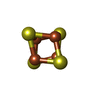

| #10: Chemical | ChemComp-SF4 / 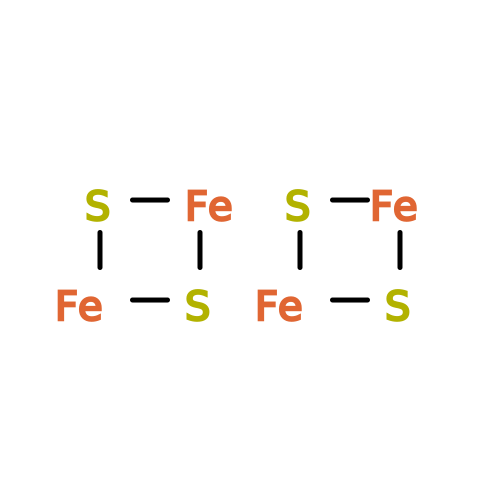 Mass: 351.640 Da / Num. of mol.: 1 / Source method: obtained synthetically / Formula: Fe4S4 Mass: 351.640 Da / Num. of mol.: 1 / Source method: obtained synthetically / Formula: Fe4S4 |
|---|---|
| #11: Chemical | ChemComp-ZN /  Mass: 65.409 Da / Num. of mol.: 6 / Source method: obtained synthetically / Formula: Zn Mass: 65.409 Da / Num. of mol.: 6 / Source method: obtained synthetically / Formula: Zn |
-Details
| Has protein modification | N |
|---|
-Experimental details
-Experiment
| Experiment | Method: ELECTRON MICROSCOPY |
|---|---|
| EM experiment | Aggregation state: PARTICLE / 3D reconstruction method: single particle reconstruction |
- Sample preparation
| Component |
| ||||||||||||||||||||||||
|---|---|---|---|---|---|---|---|---|---|---|---|---|---|---|---|---|---|---|---|---|---|---|---|---|---|
| Source (natural) |
| ||||||||||||||||||||||||
| Source (recombinant) |
| ||||||||||||||||||||||||
| Buffer solution | pH: 7.5 | ||||||||||||||||||||||||
| Specimen | Embedding applied: NO / Shadowing applied: NO / Staining applied: NO / Vitrification applied: YES | ||||||||||||||||||||||||
| Specimen support | Grid material: GOLD / Grid type: Quantifoil R2/2 | ||||||||||||||||||||||||
| Vitrification | Instrument: FEI VITROBOT MARK IV / Cryogen name: ETHANE / Humidity: 100 % / Chamber temperature: 277 K Details: 4 ul of sample was applied to glow-discharged grids which were blotted for 5s and plunge-frozen in liquid ethane. |
- Electron microscopy imaging
| Experimental equipment |  Model: Titan Krios / Image courtesy: FEI Company |
|---|---|
| Microscopy | Model: FEI TITAN KRIOS |
| Electron gun | Electron source:  FIELD EMISSION GUN / Accelerating voltage: 300 kV / Illumination mode: FLOOD BEAM FIELD EMISSION GUN / Accelerating voltage: 300 kV / Illumination mode: FLOOD BEAM |
| Electron lens | Mode: BRIGHT FIELD / Nominal magnification: 130000 X / Cs: 2.7 mm |
| Image recording | Electron dose: 41 e/Å2 / Film or detector model: GATAN K2 SUMMIT (4k x 4k) |
- Processing
| CTF correction | Type: PHASE FLIPPING AND AMPLITUDE CORRECTION |
|---|---|
| Symmetry | Point symmetry: C1 (asymmetric) |
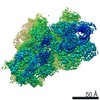
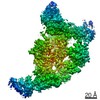
| 3D reconstruction | Resolution: 3.5 Å / Resolution method: FSC 0.143 CUT-OFF / Num. of particles: 227776 / Symmetry type: POINT |
