Ku70:Ku80 complex / negative regulation of t-circle formation / DNA end binding / Sensing of DNA Double Strand Breaks / small-subunit processome assembly / regulation of transcription by glucose / entry of viral genome into host nucleus through nuclear pore complex via importin / DNA-dependent protein kinase-DNA ligase 4 complex / nonhomologous end joining complex / positive regulation of viral life cycle ...Ku70:Ku80 complex / negative regulation of t-circle formation / DNA end binding / Sensing of DNA Double Strand Breaks / small-subunit processome assembly / regulation of transcription by glucose / entry of viral genome into host nucleus through nuclear pore complex via importin / DNA-dependent protein kinase-DNA ligase 4 complex / nonhomologous end joining complex / positive regulation of viral life cycle / NLS-dependent protein nuclear import complex / regulation of smooth muscle cell proliferation / postsynapse to nucleus signaling pathway / Cytosolic sensors of pathogen-associated DNA / nuclear telomere cap complex / IRF3-mediated induction of type I IFN / U3 snoRNA binding / nuclear import signal receptor activity / NLS-bearing protein import into nucleus / regulation of telomere maintenance / nuclear localization sequence binding / recombinational repair / non-canonical NF-kappaB signal transduction / protein localization to chromosome, telomeric region / 2-LTR circle formation / telomeric repeat DNA binding / DNA 3'-5' helicase / 3'-5' DNA helicase activity / ATP-dependent activity, acting on DNA / telomere maintenance via telomerase / positive regulation of type I interferon production / activation of innate immune response / telomere maintenance / protein import into nucleus / DNA helicase activity / DNA-(apurinic or apyrimidinic site) lyase / class I DNA-(apurinic or apyrimidinic site) endonuclease activity / site of DNA damage / cellular response to gamma radiation / small-subunit processome / Nonhomologous End-Joining (NHEJ) / protein-DNA complex / double-strand break repair via nonhomologous end joining / enzyme activator activity / histone deacetylase binding / cytoplasmic stress granule / double-strand break repair / host cell / nuclear membrane / double-stranded DNA binding / DNA recombination / secretory granule lumen / DNA-binding transcription factor binding / damaged DNA binding / chromosome, telomeric region / postsynaptic density / transcription cis-regulatory region binding / ribonucleoprotein complex / innate immune response / negative regulation of DNA-templated transcription / ubiquitin protein ligase binding / Neutrophil degranulation / DNA damage response / nucleolus / positive regulation of DNA-templated transcription / protein-containing complex binding / glutamatergic synapse / ATP hydrolysis activity / protein-containing complex / DNA binding / DNA-templated transcription / RNA binding / extracellular region / nucleoplasm / ATP binding / membrane / nucleus / cytosol / cytoplasm Similarity search - Function
Ku, C-terminal / Ku, C-terminal domain superfamily / Ku C terminal domain like / Ku80 / Ku70/Ku80 C-terminal arm / Ku70/Ku80 C-terminal arm / Ku70/Ku80, N-terminal alpha/beta / Ku70/Ku80 N-terminal alpha/beta domain / Ku70/Ku80 beta-barrel domain / Ku70 and Ku80 are 70kDa and 80kDa subunits of the Lupus Ku autoantigen ...Ku, C-terminal / Ku, C-terminal domain superfamily / Ku C terminal domain like / Ku80 / Ku70/Ku80 C-terminal arm / Ku70/Ku80 C-terminal arm / Ku70/Ku80, N-terminal alpha/beta / Ku70/Ku80 N-terminal alpha/beta domain / Ku70/Ku80 beta-barrel domain / Ku70 and Ku80 are 70kDa and 80kDa subunits of the Lupus Ku autoantigen / Ku70/Ku80 beta-barrel domain / SPOC-like, C-terminal domain superfamily / Importin subunit alpha / Atypical Arm repeat / Importin-alpha, importin-beta-binding domain superfamily / Importin beta binding domain / Atypical Arm repeat / Importin-alpha, importin-beta-binding domain / IBB domain profile. / Armadillo/plakoglobin ARM repeat profile. / Armadillo/beta-catenin-like repeat / Armadillo/beta-catenin-like repeats / Armadillo / Leucine-rich Repeat Variant / Leucine-rich Repeat Variant / von Willebrand factor (vWF) type A domain / von Willebrand factor, type A / von Willebrand factor A-like domain superfamily / Alpha Horseshoe / Armadillo-like helical / Armadillo-type fold / Mainly Alpha Similarity search - Domain/homology
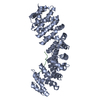
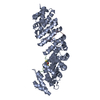
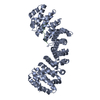
Method to determine structure: MOLECULAR REPLACEMENT / Resolution: 2.29→26.49 Å / Cor.coef. Fo:Fc: 0.96 / Cor.coef. Fo:Fc free: 0.939 / SU B: 5.11 / SU ML: 0.124 / Cross valid method: THROUGHOUT / ESU R Free: 0.178 / Stereochemistry target values: MAXIMUM LIKELIHOOD / Details: HYDROGENS HAVE BEEN ADDED IN THE RIDING POSITIONS
Rfactor
Num. reflection
% reflection
Selection details
Rfree
0.21797
1541
5 %
RANDOM
Rwork
0.17747
-
-
-
obs
0.17952
27469
98.71 %
-
all
-
29010
-
-
Solvent computation
Ion probe radii: 0.8 Å / Shrinkage radii: 0.8 Å / VDW probe radii: 1.2 Å / Solvent model: MASK
Displacement parameters
Biso mean: 41.086 Å2
Baniso -1
Baniso -2
Baniso -3
1-
0 Å2
0 Å2
0 Å2
2-
-
-0.01 Å2
0 Å2
3-
-
-
0 Å2
Refinement step
Cycle: LAST / Resolution: 2.29→26.49 Å
Protein
Nucleic acid
Ligand
Solvent
Total
Num. atoms
3295
0
0
216
3511
Refine LS restraints
Refine-ID
Type
Dev ideal
Dev ideal target
Number
X-RAY DIFFRACTION
r_bond_refined_d
0.022
0.022
3356
X-RAY DIFFRACTION
r_angle_refined_deg
1.984
1.97
4576
X-RAY DIFFRACTION
r_dihedral_angle_1_deg
6.174
5
435
X-RAY DIFFRACTION
r_dihedral_angle_2_deg
42.474
25.859
128
X-RAY DIFFRACTION
r_dihedral_angle_3_deg
16.768
15
570
X-RAY DIFFRACTION
r_dihedral_angle_4_deg
20.157
15
11
X-RAY DIFFRACTION
r_chiral_restr
0.131
0.2
557
X-RAY DIFFRACTION
r_gen_planes_refined
0.008
0.02
2463
X-RAY DIFFRACTION
r_nbd_refined
0.232
0.2
2046
X-RAY DIFFRACTION
r_nbtor_refined
0.313
0.2
2406
X-RAY DIFFRACTION
r_xyhbond_nbd_refined
0.167
0.2
258
X-RAY DIFFRACTION
r_symmetry_vdw_refined
0.188
0.2
56
X-RAY DIFFRACTION
r_symmetry_hbond_refined
0.147
0.2
15
X-RAY DIFFRACTION
r_mcbond_it
1.171
1.5
2210
X-RAY DIFFRACTION
r_mcangle_it
2.148
2
3518
X-RAY DIFFRACTION
r_scbond_it
3.377
3
1264
X-RAY DIFFRACTION
r_scangle_it
5.35
4.5
1058
LS refinement shell
Resolution: 2.29→2.349 Å / Total num. of bins used: 20
Rfactor
Num. reflection
% reflection
Rfree
0.516
103
-
Rwork
0.344
1887
-
obs
-
-
88.44 %
+
About Yorodumi
-
News
-
Feb 9, 2022. New format data for meta-information of EMDB entries
New format data for meta-information of EMDB entries
Version 3 of the EMDB header file is now the official format.
The previous official version 1.9 will be removed from the archive.
In the structure databanks used in Yorodumi, some data are registered as the other names, "COVID-19 virus" and "2019-nCoV". Here are the details of the virus and the list of structure data.
Jan 31, 2019. EMDB accession codes are about to change! (news from PDBe EMDB page)
EMDB accession codes are about to change! (news from PDBe EMDB page)
The allocation of 4 digits for EMDB accession codes will soon come to an end. Whilst these codes will remain in use, new EMDB accession codes will include an additional digit and will expand incrementally as the available range of codes is exhausted. The current 4-digit format prefixed with “EMD-” (i.e. EMD-XXXX) will advance to a 5-digit format (i.e. EMD-XXXXX), and so on. It is currently estimated that the 4-digit codes will be depleted around Spring 2019, at which point the 5-digit format will come into force.
The EM Navigator/Yorodumi systems omit the EMD- prefix.
Related info.:Q: What is EMD? / ID/Accession-code notation in Yorodumi/EM Navigator
Yorodumi is a browser for structure data from EMDB, PDB, SASBDB, etc.
This page is also the successor to EM Navigator detail page, and also detail information page/front-end page for Omokage search.
The word "yorodu" (or yorozu) is an old Japanese word meaning "ten thousand". "mi" (miru) is to see.
Related info.:EMDB / PDB / SASBDB / Comparison of 3 databanks / Yorodumi Search / Aug 31, 2016. New EM Navigator & Yorodumi / Yorodumi Papers / Jmol/JSmol / Function and homology information / Changes in new EM Navigator and Yorodumi
 Movie
Movie Controller


 Open data
 Basic information
 Components
 Keywords
 Function and homology information
 Mus musculus (house mouse)
 Homo sapiens (human)
 X-RAY DIFFRACTION /
  Authors
 Citation
 Structure visualization
 Downloads & links
 Other downloads




 PDBj
PDBj
 Assembly

 Escherichia coli (E. coli) / Strain (production host): BL21(DE3)pLysS / References: UniProt: P52293
 Mass: 18.015 Da / Num. of mol.: 216 / Source method: isolated from a natural source / Formula: H2O
 Sample preparation
 / Beamline: D03B-MX1 / Wavelength: 1.43 Å
 Processing