 Movie
Movie Controller

[English] 日本語
 Yorodumi
- PDB-3kfd: Ternary complex of TGF-b1 reveals isoform-specific ligand recogni... -
+ Open data

- Basic information
| Entry | Database: PDB / ID: 3kfd | ||||||
|---|---|---|---|---|---|---|---|
| Title | Ternary complex of TGF-b1 reveals isoform-specific ligand recognition and receptor recruitment in the superfamily | ||||||
 Components Components |
| ||||||
 Keywords Keywords | CYTOKINE/CYTOKINE RECEPTOR / TGF-beta / TGF-b1 / TGF-beta receptor type-1 / TGF-beta receptor type-2 / TbRII / TbRI / Growth factor / Receptor / Serine/threonine-protein kinase / CYTOKINE-CYTOKINE RECEPTOR complex | ||||||
| Function / homology |  Function and homology information Function and homology informationpositive regulation of tolerance induction to self antigen / positive regulation of B cell tolerance induction / inferior endocardial cushion morphogenesis / transforming growth factor beta receptor activity, type II / frontal suture morphogenesis / Influenza Virus Induced Apoptosis / adaptive immune response based on somatic recombination of immune receptors built from immunoglobulin superfamily domains / positive regulation of microglia differentiation / regulation of interleukin-23 production / positive regulation of primary miRNA processing ...positive regulation of tolerance induction to self antigen / positive regulation of B cell tolerance induction / inferior endocardial cushion morphogenesis / transforming growth factor beta receptor activity, type II / frontal suture morphogenesis / Influenza Virus Induced Apoptosis / adaptive immune response based on somatic recombination of immune receptors built from immunoglobulin superfamily domains / positive regulation of microglia differentiation / regulation of interleukin-23 production / positive regulation of primary miRNA processing / morphogenesis of a branching structure / negative regulation of skeletal muscle tissue development / embryonic liver development / regulation of striated muscle tissue development / extracellular structure organization / epicardium morphogenesis / tricuspid valve morphogenesis / vascular endothelial cell proliferation / response to laminar fluid shear stress / parathyroid gland development / heart valve morphogenesis / macrophage derived foam cell differentiation / TGFBR2 MSI Frameshift Mutants in Cancer / miRNA transport / positive regulation of T cell tolerance induction / aorta morphogenesis / regulation of protein import into nucleus / regulation of blood vessel remodeling / regulation of cardiac muscle cell proliferation / transforming growth factor beta complex / negative regulation of macrophage cytokine production / cellular response to acetaldehyde / connective tissue replacement involved in inflammatory response wound healing / negative regulation of natural killer cell mediated cytotoxicity directed against tumor cell target / negative regulation of hyaluronan biosynthetic process / extracellular matrix assembly / type III transforming growth factor beta receptor binding / positive regulation of epithelial to mesenchymal transition involved in endocardial cushion formation / myofibroblast differentiation / transforming growth factor beta receptor activity / TGFBR2 Kinase Domain Mutants in Cancer / odontoblast differentiation / cardiac left ventricle morphogenesis / trophoblast cell migration / positive regulation of exit from mitosis / salivary gland morphogenesis / membranous septum morphogenesis / positive regulation of isotype switching to IgA isotypes / negative regulation of neuroblast proliferation / pharyngeal system development / myeloid dendritic cell differentiation / secondary palate development / SMAD2/3 Phosphorylation Motif Mutants in Cancer / TGFBR1 KD Mutants in Cancer / angiogenesis involved in coronary vascular morphogenesis / positive regulation of CD4-positive, alpha-beta T cell proliferation / positive regulation of mesenchymal stem cell proliferation / endocardial cushion fusion / positive regulation of NK T cell differentiation / positive regulation of receptor signaling pathway via STAT / ventricular compact myocardium morphogenesis / membrane protein intracellular domain proteolysis / positive regulation of tight junction disassembly / positive regulation of extracellular matrix assembly / cardiac epithelial to mesenchymal transition / neuron fate commitment / mesenchymal cell differentiation / transforming growth factor beta receptor activity, type I / negative regulation of myoblast differentiation / TGFBR3 regulates TGF-beta signaling / neural tube development / positive regulation of vasculature development / activin receptor activity, type I / activin receptor complex / primordial germ cell migration / regulation of epithelial to mesenchymal transition / hyaluronan catabolic process / anterior/posterior pattern specification / ATP biosynthetic process / positive regulation of mesenchymal cell proliferation / cell-cell junction organization / receptor protein serine/threonine kinase / type II transforming growth factor beta receptor binding / activin binding / negative regulation of extracellular matrix disassembly / embryonic cranial skeleton morphogenesis / positive regulation of branching involved in ureteric bud morphogenesis / transmembrane receptor protein serine/threonine kinase activity / receptor catabolic process / response to salt / positive regulation of cardiac muscle cell differentiation / TGFBR1 LBD Mutants in Cancer / atrioventricular valve morphogenesis / regulatory T cell differentiation / positive regulation of chemotaxis / ventricular trabecula myocardium morphogenesis / coronary artery morphogenesis / negative regulation of cell-cell adhesion mediated by cadherin / glycosaminoglycan binding / regulation of stem cell differentiation Similarity search - Function | ||||||
| Biological species |  Homo sapiens (human) Homo sapiens (human) | ||||||
| Method |  X-RAY DIFFRACTION / SYNCHROTRON / MOLECULAR REPLACEMENT / Resolution: 2.995 Å X-RAY DIFFRACTION / SYNCHROTRON / MOLECULAR REPLACEMENT / Resolution: 2.995 Å | ||||||
 Authors Authors | Radaev, S. / Sun, P.D. | ||||||
 Citation Citation | Journal: J.Biol.Chem. / Year: 2010 Title: Ternary complex of transforming growth factor-beta1 reveals isoform-specific ligand recognition and receptor recruitment in the superfamily. Authors: Radaev, S. / Zou, Z. / Huang, T. / Lafer, E.M. / Hinck, A.P. / Sun, P.D. | ||||||
| History |
|
- Structure visualization
| Structure viewer | Molecule: MolmilJmol/JSmol |
|---|
- Downloads & links
-Download
| PDBx/mmCIF format | 3kfd.cif.gz | 238.4 KB | Display | PDBx/mmCIF format |
|---|---|---|---|---|
| PDB format | pdb3kfd.ent.gz | 192 KB | Display | PDB format |
| PDBx/mmJSON format | 3kfd.json.gz | Tree view | PDBx/mmJSON format | |
| Others |  Other downloads Other downloads |
-Validation report
| Arichive directory | https://data.pdbj.org/pub/pdb/validation_reports/kf/3kfdftp://data.pdbj.org/pub/pdb/validation_reports/kf/3kfd | HTTPS FTP |
|---|
-Related structure data





-Links
 PDBj
PDBj
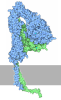
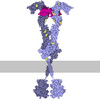
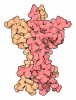

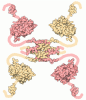
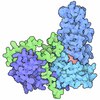
- Assembly
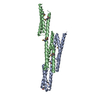
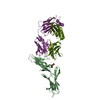
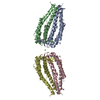
| Deposited unit | 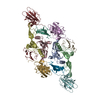
| ||||||||
|---|---|---|---|---|---|---|---|---|---|
| 1 | 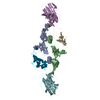
| ||||||||
| 2 | 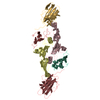
| ||||||||
| 3 |
| ||||||||
| Unit cell |
| ||||||||
| Details | Hexamer |
-Components
| #1: Protein | Mass: 12809.812 Da / Num. of mol.: 4 Source method: isolated from a genetically manipulated source Source: (gene. exp.) Homo sapiens (human) / Gene: TGFB1, TGFB / Organ (production host): ovary cells / Production host:   Cricetulus griseus (Chinese hamster) / Strain (production host): CHO-lec3.2.8.1 / References: UniProt: P01137 Cricetulus griseus (Chinese hamster) / Strain (production host): CHO-lec3.2.8.1 / References: UniProt: P01137#2: Protein | Mass: 13225.042 Da / Num. of mol.: 4 / Fragment: extracellular domain Source method: isolated from a genetically manipulated source Source: (gene. exp.) Homo sapiens (human) / Gene: TGFBR2 / Production host:   Escherichia coli (E. coli) / References: UniProt: P37173 Escherichia coli (E. coli) / References: UniProt: P37173#3: Protein | Mass: 9330.697 Da / Num. of mol.: 4 / Fragment: extracellular domain Source method: isolated from a genetically manipulated source Source: (gene. exp.) Homo sapiens (human) / Gene: TGFBR1 / Production host: Escherichia coli (E. coli) / References: UniProt: P36897#4: Water | ChemComp-HOH / |  Mass: 18.015 Da / Num. of mol.: 93 / Source method: isolated from a natural source / Formula: H2O Mass: 18.015 Da / Num. of mol.: 93 / Source method: isolated from a natural source / Formula: H2OHas protein modification | Y | |
|---|
-Experimental details
-Experiment
| Experiment | Method: X-RAY DIFFRACTION / Number of used crystals: 1 |
|---|
- Sample preparation
| Crystal | Density Matthews: 2.43 Å3/Da / Density % sol: 49.34 % |
|---|---|
| Crystal grow | Temperature: 298 K / Method: vapor diffusion / pH: 7 Details: 8-15% Peg 4000-8000, pH 7.0, VAPOR DIFFUSION, temperature 298K |
-Data collection
| Diffraction | Mean temperature: 100 K |
|---|---|
| Diffraction source | Source: SYNCHROTRON / Site: APS  / Beamline: 22-ID / Wavelength: 1 Å / Beamline: 22-ID / Wavelength: 1 Å |
| Detector | Type: MARMOSAIC 300 mm CCD / Detector: CCD / Date: Oct 10, 2007 / Details: mirrors |
| Radiation | Monochromator: SI(111) / Protocol: SINGLE WAVELENGTH / Monochromatic (M) / Laue (L): M / Scattering type: x-ray |
| Radiation wavelength | Wavelength: 1 Å / Relative weight: 1 |
| Reflection | Resolution: 3→50 Å / Num. obs: 23426 / Observed criterion σ(I): -3 / Redundancy: 1.9 % / Rsym value: 0.08 / Net I/σ(I): 9.2 |
| Reflection shell | Resolution: 3→3.11 Å / Redundancy: 1.6 % / Mean I/σ(I) obs: 2 / Num. unique all: 1223 / Rsym value: 0.245 |
- Processing
| Software |
| |||||||||||||||||||||||||||||||||||||||||||||||||||||||||||||||
|---|---|---|---|---|---|---|---|---|---|---|---|---|---|---|---|---|---|---|---|---|---|---|---|---|---|---|---|---|---|---|---|---|---|---|---|---|---|---|---|---|---|---|---|---|---|---|---|---|---|---|---|---|---|---|---|---|---|---|---|---|---|---|---|---|
| Refinement | Method to determine structure: MOLECULAR REPLACEMENT Starting model: PDB entries 2TGI, 1M9Z, 1REW Resolution: 2.995→46.08 Å / Occupancy max: 1 / Occupancy min: 0 / FOM work R set: 0.763 / SU ML: 0.41 / Isotropic thermal model: Isotropic / σ(F): 0.06 / Phase error: 30.61 / Stereochemistry target values: ML
| |||||||||||||||||||||||||||||||||||||||||||||||||||||||||||||||
| Solvent computation | Shrinkage radii: 0.9 Å / VDW probe radii: 1.11 Å / Solvent model: FLAT BULK SOLVENT MODEL / Bsol: 41.915 Å2 / ksol: 0.322 e/Å3 | |||||||||||||||||||||||||||||||||||||||||||||||||||||||||||||||
| Displacement parameters | Biso max: 164.87 Å2 / Biso mean: 73.45 Å2 / Biso min: 16.27 Å2
| |||||||||||||||||||||||||||||||||||||||||||||||||||||||||||||||
| Refinement step | Cycle: LAST / Resolution: 2.995→46.08 Å
| |||||||||||||||||||||||||||||||||||||||||||||||||||||||||||||||
| Refine LS restraints |
| |||||||||||||||||||||||||||||||||||||||||||||||||||||||||||||||
| LS refinement shell |
|
