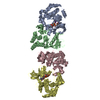
Movie
Movie Controller


+ Open data

- Basic information
| Entry | Database: PDB / ID: 6q0k | |||||||||
|---|---|---|---|---|---|---|---|---|---|---|
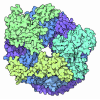
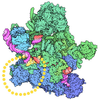
| Title | Structure of a MAPK pathway complex | |||||||||
 Components Components |
| |||||||||
 Keywords Keywords | SIGNALING PROTEIN/Transferase / TRANSFERASE / SIGNALING PROTEIN-Transferase complex | |||||||||
| Function / homology |  Function and homology information Function and homology informationsynaptic target recognition / Golgi reassembly / CD4-positive, alpha-beta T cell differentiation / NOTCH4 Activation and Transmission of Signal to the Nucleus / positive regulation of axon regeneration / myeloid progenitor cell differentiation / respiratory system process / CD4-positive or CD8-positive, alpha-beta T cell lineage commitment / negative regulation of synaptic vesicle exocytosis / establishment of Golgi localization ...synaptic target recognition / Golgi reassembly / CD4-positive, alpha-beta T cell differentiation / NOTCH4 Activation and Transmission of Signal to the Nucleus / positive regulation of axon regeneration / myeloid progenitor cell differentiation / respiratory system process / CD4-positive or CD8-positive, alpha-beta T cell lineage commitment / negative regulation of synaptic vesicle exocytosis / establishment of Golgi localization / tube formation / Signalling to p38 via RIT and RIN / head morphogenesis / endothelial cell apoptotic process / ARMS-mediated activation / negative regulation of fibroblast migration / SHOC2 M1731 mutant abolishes MRAS complex function / Gain-of-function MRAS complexes activate RAF signaling / regulation of synapse maturation / Rap1 signalling / positive regulation of D-glucose transmembrane transport / establishment of protein localization to membrane / positive regulation of axonogenesis / somatic stem cell population maintenance / regulation of T cell differentiation / negative regulation of protein localization to nucleus / face development / KSRP (KHSRP) binds and destabilizes mRNA / thyroid gland development / Negative feedback regulation of MAPK pathway / GP1b-IX-V activation signalling / Frs2-mediated activation / stress fiber assembly / MAP kinase kinase activity / Regulation of localization of FOXO transcription factors / Interleukin-3, Interleukin-5 and GM-CSF signaling / lung development / synaptic vesicle exocytosis / positive regulation of peptidyl-serine phosphorylation / phosphoserine residue binding / Activation of BAD and translocation to mitochondria / negative regulation of endothelial cell apoptotic process / MAP kinase kinase kinase activity / ERK1 and ERK2 cascade / centriolar satellite / regulation of ERK1 and ERK2 cascade / SARS-CoV-2 targets host intracellular signalling and regulatory pathways / thymus development / postsynaptic modulation of chemical synaptic transmission / cellular response to glucose starvation / Chk1/Chk2(Cds1) mediated inactivation of Cyclin B:Cdk1 complex / SARS-CoV-1 targets host intracellular signalling and regulatory pathways / positive regulation of stress fiber assembly / RHO GTPases activate PKNs / substrate adhesion-dependent cell spreading / positive regulation of substrate adhesion-dependent cell spreading / negative regulation of TORC1 signaling / Transcriptional and post-translational regulation of MITF-M expression and activity / T cell differentiation in thymus / animal organ morphogenesis / cellular response to calcium ion / negative regulation of innate immune response / hippocampal mossy fiber to CA3 synapse / TP53 Regulates Metabolic Genes / Translocation of SLC2A4 (GLUT4) to the plasma membrane / sperm principal piece / sperm end piece / cellular response to xenobiotic stimulus / regulation of protein stability / protein sequestering activity / Deactivation of the beta-catenin transactivating complex / visual learning / RAF activation / Signaling by high-kinase activity BRAF mutants / Spry regulation of FGF signaling / MAP2K and MAPK activation / Negative regulation of NOTCH4 signaling / long-term synaptic potentiation / epidermal growth factor receptor signaling pathway / intracellular protein localization / sperm midpiece / Signaling by RAF1 mutants / Signaling by moderate kinase activity BRAF mutants / Paradoxical activation of RAF signaling by kinase inactive BRAF / Signaling downstream of RAS mutants / MAPK cascade / Negative regulation of MAPK pathway / melanosome / Signaling by BRAF and RAF1 fusions / regulation of cell population proliferation / T cell receptor signaling pathway / presynapse / angiogenesis / cell body / scaffold protein binding / cilium / protein phosphatase binding / blood microparticle / negative regulation of neuron apoptotic process / DNA-binding transcription factor binding Similarity search - Function | |||||||||
| Biological species |  Homo sapiens (human) Homo sapiens (human) | |||||||||
| Method | ELECTRON MICROSCOPY / single particle reconstruction / cryo EM / Resolution: 6.8 Å | |||||||||
 Authors Authors | Park, E. / Rawson, S. / Jeon, H. / Eck, M.J. | |||||||||
| Funding support |  United States, 2items United States, 2items
| |||||||||
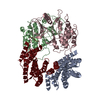
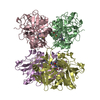
 Citation Citation | Journal: Nature / Year: 2019 Title: Architecture of autoinhibited and active BRAF-MEK1-14-3-3 complexes. Authors: Eunyoung Park / Shaun Rawson / Kunhua Li / Byeong-Won Kim / Scott B Ficarro / Gonzalo Gonzalez-Del Pino / Humayun Sharif / Jarrod A Marto / Hyesung Jeon / Michael J Eck / Abstract: RAF family kinases are RAS-activated switches that initiate signalling through the MAP kinase cascade to control cellular proliferation, differentiation and survival. RAF activity is tightly ...RAF family kinases are RAS-activated switches that initiate signalling through the MAP kinase cascade to control cellular proliferation, differentiation and survival. RAF activity is tightly regulated and inappropriate activation is a frequent cause of cancer; however, the structural basis for RAF regulation is poorly understood at present. Here we use cryo-electron microscopy to determine autoinhibited and active-state structures of full-length BRAF in complexes with MEK1 and a 14-3-3 dimer. The reconstruction reveals an inactive BRAF-MEK1 complex restrained in a cradle formed by the 14-3-3 dimer, which binds the phosphorylated S365 and S729 sites that flank the BRAF kinase domain. The BRAF cysteine-rich domain occupies a central position that stabilizes this assembly, but the adjacent RAS-binding domain is poorly ordered and peripheral. The 14-3-3 cradle maintains autoinhibition by sequestering the membrane-binding cysteine-rich domain and blocking dimerization of the BRAF kinase domain. In the active state, these inhibitory interactions are released and a single 14-3-3 dimer rearranges to bridge the C-terminal pS729 binding sites of two BRAFs, which drives the formation of an active, back-to-back BRAF dimer. Our structural snapshots provide a foundation for understanding normal RAF regulation and its mutational disruption in cancer and developmental syndromes. | |||||||||
| History |
|
- Structure visualization
| Movie |
Movie viewer |
|---|---|
| Structure viewer | Molecule: MolmilJmol/JSmol |
- Downloads & links
-Download
| PDBx/mmCIF format | 6q0k.cif.gz | 182.6 KB | Display | PDBx/mmCIF format |
|---|---|---|---|---|
| PDB format | pdb6q0k.ent.gz | 114 KB | Display | PDB format |
| PDBx/mmJSON format | 6q0k.json.gz | Tree view | PDBx/mmJSON format | |
| Others |  Other downloads Other downloads |
-Validation report
| Arichive directory | https://data.pdbj.org/pub/pdb/validation_reports/q0/6q0kftp://data.pdbj.org/pub/pdb/validation_reports/q0/6q0k | HTTPS FTP |
|---|
-Related structure data
| Related structure data | 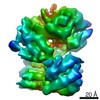 20551MC 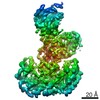 0541C 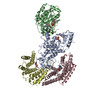 6nybC 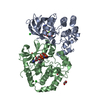 6pp9C 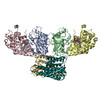 6q0jC 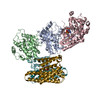 6q0tC M: map data used to model this data C: citing same article ( |
|---|---|
| Similar structure data |


-Links
 PDBj
PDBj

- Assembly
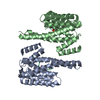
| Deposited unit | 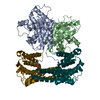
|
|---|---|
| 1 |
|
-Components
| #1: Protein | Mass: 89322.812 Da / Num. of mol.: 2 Source method: isolated from a genetically manipulated source Source: (gene. exp.) Homo sapiens (human) / Gene: BRAF, BRAF1, RAFB1 / Production host: Homo sapiens (human)References: UniProt: P15056, non-specific serine/threonine protein kinase #2: Protein | Mass: 27777.092 Da / Num. of mol.: 2 / Source method: isolated from a natural source / Source: (natural) Homo sapiens (human) / References: UniProt: P63104Has ligand of interest | Y | Has protein modification | Y | |
|---|
-Experimental details
-Experiment
| Experiment | Method: ELECTRON MICROSCOPY |
|---|---|
| EM experiment | Aggregation state: PARTICLE / 3D reconstruction method: single particle reconstruction |
- Sample preparation
| Component | Name: ERK pathway complex / Type: COMPLEX / Entity ID: all / Source: MULTIPLE SOURCES |
|---|---|
| Molecular weight | Value: 233 kDa/nm / Experimental value: YES |
| Source (natural) | Organism: Homo sapiens (human) |
| Source (recombinant) | Organism:  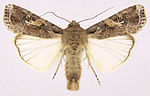 Spodoptera frugiperda (fall armyworm) Spodoptera frugiperda (fall armyworm) |
| Buffer solution | pH: 7.5 |
| Specimen | Embedding applied: NO / Shadowing applied: NO / Staining applied: NO / Vitrification applied: YES |
| Specimen support | Details: unspecified |
| Vitrification | Cryogen name: ETHANE |
- Electron microscopy imaging
| Experimental equipment |  Model: Titan Krios / Image courtesy: FEI Company |
|---|---|
| Microscopy | Model: FEI TITAN KRIOS |
| Electron gun | Electron source:  FIELD EMISSION GUN / Accelerating voltage: 300 kV / Illumination mode: OTHER FIELD EMISSION GUN / Accelerating voltage: 300 kV / Illumination mode: OTHER |
| Electron lens | Mode: OTHER |
| Image recording | Electron dose: 60 e/Å2 / Film or detector model: GATAN K3 (6k x 4k) |
- Processing
| CTF correction | Type: NONE | |||||||||||||||||||||||||
|---|---|---|---|---|---|---|---|---|---|---|---|---|---|---|---|---|---|---|---|---|---|---|---|---|---|---|
| 3D reconstruction | Resolution: 6.8 Å / Resolution method: FSC 0.143 CUT-OFF / Num. of particles: 66215 / Symmetry type: POINT | |||||||||||||||||||||||||
| Atomic model building | Protocol: RIGID BODY FIT / Space: REAL | |||||||||||||||||||||||||
| Atomic model building | 3D fitting-ID: 1 / Source name: PDB / Type: experimental model
|