 Movie
Movie Controller

[English] 日本語
 Yorodumi
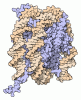
- EMDB-71627: Human SRCAP-nucleosome complex in the fully-engaged state, with H... -
+ Open data

- Basic information
| Entry |  | |||||||||
|---|---|---|---|---|---|---|---|---|---|---|
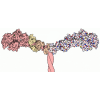
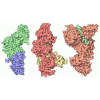
| Title | Human SRCAP-nucleosome complex in the fully-engaged state, with H4-bound GAS41 (unmasked refinement, filtered by local resolution) | |||||||||
 Map data Map data | ||||||||||
 Sample Sample |
| |||||||||
 Keywords Keywords | Chromatin Remodeler / Snf2 family ATPase / H2A.Z / GENE REGULATION | |||||||||
| Function / homology |  Function and homology information Function and homology informationpositive regulation of lymphoid progenitor cell differentiation / histone H3K18ac reader activity / catalytic activity, acting on a protein / hematopoietic stem cell homeostasis / intestinal stem cell homeostasis / RPAP3/R2TP/prefoldin-like complex / promoter-enhancer loop anchoring activity / telomerase RNA localization to Cajal body / npBAF complex / positive regulation of norepinephrine uptake ...positive regulation of lymphoid progenitor cell differentiation / histone H3K18ac reader activity / catalytic activity, acting on a protein / hematopoietic stem cell homeostasis / intestinal stem cell homeostasis / RPAP3/R2TP/prefoldin-like complex / promoter-enhancer loop anchoring activity / telomerase RNA localization to Cajal body / npBAF complex / positive regulation of norepinephrine uptake / muscle cell differentiation / positive regulation of telomere maintenance in response to DNA damage / regulation of DNA strand elongation / histone chaperone activity / R2TP complex / dynein axonemal particle / cellular response to cytochalasin B / neural retina development / Formation of the embryonic stem cell BAF (esBAF) complex / regulation of transepithelial transport / Activation of the TFAP2 (AP-2) family of transcription factors / Formation of the canonical BAF (cBAF) complex / morphogenesis of a polarized epithelium / Formation of annular gap junctions / Formation of the dystrophin-glycoprotein complex (DGC) / structural constituent of postsynaptic actin cytoskeleton / Swr1 complex / Formation of the polybromo-BAF (pBAF) complex / Gap junction degradation / GBP-mediated host defense / protein localization to adherens junction / Formation of neuronal progenitor and neuronal BAF (npBAF and nBAF) / establishment of protein localization to chromatin / Formation of the non-canonical BAF (ncBAF) complex / Cell-extracellular matrix interactions / heart process / regulation of G0 to G1 transition / dense body / Folding of actin by CCT/TriC / Tat protein binding / postsynaptic actin cytoskeleton / Ino80 complex / Regulation of CDH1 Function / apical protein localization / negative regulation of transcription by RNA polymerase I / Prefoldin mediated transfer of substrate to CCT/TriC / Adherens junctions interactions / regulation of double-strand break repair / microtubule nucleation / SWI/SNF complex / adherens junction assembly / RHOF GTPase cycle / box C/D snoRNP assembly / Sensory processing of sound by outer hair cells of the cochlea / ATP-dependent chromatin remodeler activity / tight junction / Sensory processing of sound by inner hair cells of the cochlea / nucleolus organization / regulation of mitotic metaphase/anaphase transition / positive regulation of DNA damage response, signal transduction by p53 class mediator / spinal cord development / positive regulation of T cell differentiation / maintenance of blood-brain barrier / Interaction between L1 and Ankyrins / apical junction complex / regulation of nucleotide-excision repair / positive regulation of stem cell population maintenance / regulation of chromosome organization / positive regulation of transcription by RNA polymerase I / NuA4 histone acetyltransferase complex / regulation of norepinephrine uptake / transporter regulator activity / histone H3K27ac reader activity / Recycling pathway of L1 / cortical cytoskeleton / positive regulation of double-strand break repair / MLL1 complex / Regulation of MITF-M-dependent genes involved in pigmentation / negative regulation of cell differentiation / establishment or maintenance of cell polarity / regulation of DNA replication / RUNX1 interacts with co-factors whose precise effect on RUNX1 targets is not known / nitric-oxide synthase binding / TFIID-class transcription factor complex binding / brush border / EPH-ephrin mediated repulsion of cells / protein folding chaperone complex / Telomere Extension By Telomerase / positive regulation of transcription initiation by RNA polymerase II / regulation of synaptic vesicle endocytosis / positive regulation of myoblast differentiation / RHO GTPases Activate WASPs and WAVEs / cAMP/PKA signal transduction / kinesin binding / RNA polymerase II core promoter sequence-specific DNA binding / calcium ion homeostasis / regulation of protein localization to plasma membrane / RHO GTPases activate IQGAPs / positive regulation of double-strand break repair via homologous recombination / nucleosome binding Similarity search - Function | |||||||||
| Biological species |  Homo sapiens (human) Homo sapiens (human) | |||||||||
| Method | single particle reconstruction / cryo EM / Resolution: 7.1 Å | |||||||||
 Authors Authors | Louder RK / Park G | |||||||||
| Funding support |  United States, 1 items United States, 1 items
| |||||||||
 Citation Citation | Journal: Sci Adv / Year: 2026 Title: Structural mechanism of histone H2A.Z exchange by human SRCAP-CFDP1 holoenzyme. Authors: Giho Park / Carl Wu / Robert K Louder / Abstract: The conserved yeast SWR1 and human SRCAP chromatin remodeling complexes catalyze exchange of nucleosomal histone H2A for H2A.Z, but the underlying mechanism has remained obscure. Here, we show that ...The conserved yeast SWR1 and human SRCAP chromatin remodeling complexes catalyze exchange of nucleosomal histone H2A for H2A.Z, but the underlying mechanism has remained obscure. Here, we show that histone exchange by SRCAP requires the transient activator CFDP1 and resolve nine cryo-electron microscopy structures of the SRCAP-CFDP1 holoenzyme that define the stepwise exchange mechanism. CFDP1 recognizes the conformation of the fully engaged SRCAP-nucleosome complex through interactions with multiple subunits-including direct contact with the ATPase domain-and induces conformational transitions that drive extensive DNA unwrapping, eviction of the H2A-H2B dimer, and insertion of the H2A.Z-H2B dimer, all without necessarily requiring hydrolysis of bound ATP. Collectively, these findings provide unprecedented insight into the mechanism of activator- and nucleotide-driven histone exchange from nucleosomal H2A to H2A.Z. | |||||||||
| History |
|
- Structure visualization
| Supplemental images |
|---|

- Downloads & links
-EMDB archive
| Map data | emd_71627.map.gz | 123.9 MB | EMDB map data format | |
|---|---|---|---|---|
| Header (meta data) | emd-71627-v30.xmlemd-71627.xml | 13.9 KB 13.9 KB | Display Display | EMDB header |
| FSC (resolution estimation) | emd_71627_fsc.xml | 13.8 KB | Display | FSC data file |
| Images |  emd_71627.png emd_71627.png | 106.4 KB | ||
| Masks | emd_71627_msk_1.map | 216 MB | Mask map | |
| Filedesc metadata | emd-71627.cif.gz | 4.1 KB | ||
| Others | emd_71627_half_map_1.map.gzemd_71627_half_map_2.map.gz | 171.4 MB 171.5 MB | ||
| Archive directory |  http://ftp.pdbj.org/pub/emdb/structures/EMD-71627ftp://ftp.pdbj.org/pub/emdb/structures/EMD-71627 http://ftp.pdbj.org/pub/emdb/structures/EMD-71627ftp://ftp.pdbj.org/pub/emdb/structures/EMD-71627 | HTTPS FTP |
-Related structure data
| Related structure data |  9y3dMC  9ca7C  9ca8C  9ca9C  9caaC  9nfvC  9nfwC  9nfxC  9nfyC  9nfzC  9ng0C  9pgcC  9pgdC  9y3eC  9y3fC  9y3gC  9y3hC  9zlaC M: atomic model generated by this map C: citing same article ( |
|---|---|
| Similar structure data |


-Links
| EMDB pages | EMDB (EBI/PDBe) / EMDataResource |
|---|---|
| Related items in Molecule of the Month |

-Map
| File | Download / File: emd_71627.map.gz / Format: CCP4 / Size: 216 MB / Type: IMAGE STORED AS FLOATING POINT NUMBER (4 BYTES) | ||||||||||||||||||||||||||||||||||||
|---|---|---|---|---|---|---|---|---|---|---|---|---|---|---|---|---|---|---|---|---|---|---|---|---|---|---|---|---|---|---|---|---|---|---|---|---|---|
| Projections & slices | Image control
Images are generated by Spider. | ||||||||||||||||||||||||||||||||||||
| Voxel size | X=Y=Z: 1.025 Å | ||||||||||||||||||||||||||||||||||||
| Density |
| ||||||||||||||||||||||||||||||||||||
| Symmetry | Space group: 1 | ||||||||||||||||||||||||||||||||||||
| Details | EMDB XML:
|
 Z (Sec.)
 Y (Row.)
 X (Col.)


-Supplemental data
-Mask #1
| File | emd_71627_msk_1.map | ||||||||||||
|---|---|---|---|---|---|---|---|---|---|---|---|---|---|
| Projections & Slices |
| ||||||||||||
| Density Histograms |


-Half map: #1
| File | emd_71627_half_map_1.map | ||||||||||||
|---|---|---|---|---|---|---|---|---|---|---|---|---|---|
| Projections & Slices |
| ||||||||||||
| Density Histograms |


-Half map: #2
| File | emd_71627_half_map_2.map | ||||||||||||
|---|---|---|---|---|---|---|---|---|---|---|---|---|---|
| Projections & Slices |
| ||||||||||||
| Density Histograms |


- Sample components
-Entire : SRCAP-nucleosome complex
| Entire | Name: SRCAP-nucleosome complex |
|---|---|
| Components |
|
-Supramolecule #1: SRCAP-nucleosome complex
| Supramolecule | Name: SRCAP-nucleosome complex / type: complex / ID: 1 / Parent: 0 Details: Endogenous purified SRCAP bound to 106N32 nucleosome |
|---|---|
| Source (natural) | Organism: Homo sapiens (human) / Strain: K-562 / Organ: BLOOD / Tissue: BONE MARROW / Organelle: NUCLEUS / Location in cell: NUCLEOPLASM |
-Experimental details
-Structure determination
| Method | cryo EM |
|---|---|
 Processing Processing | single particle reconstruction |
| Aggregation state | particle |
-Sample preparation
| Buffer | pH: 7.6 |
|---|---|
| Vitrification | Cryogen name: ETHANE |
- Electron microscopy
| Microscope | TFS KRIOS |
|---|---|
| Image recording | Film or detector model: GATAN K3 (6k x 4k) / Average electron dose: 50.0 e/Å2 |
| Electron beam | Acceleration voltage: 300 kV / Electron source:  FIELD EMISSION GUN FIELD EMISSION GUN |
| Electron optics | Illumination mode: FLOOD BEAM / Imaging mode: BRIGHT FIELD / Nominal defocus max: 1.6 µm / Nominal defocus min: 0.8 µm |
| Experimental equipment |  Model: Titan Krios / Image courtesy: FEI Company |

