 Movie
Movie Controller

[English] 日本語
 Yorodumi
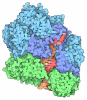
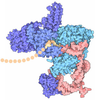
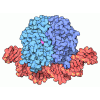
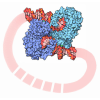
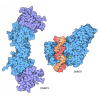
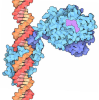
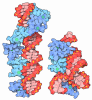
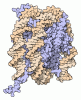
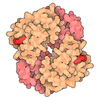
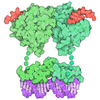
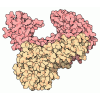
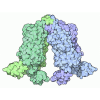
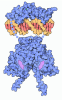
- PDB-9pgc: Trident submodule from human SRCAP-nucleosome complex in the full... -
+ Open data

- Basic information
| Entry | Database: PDB / ID: 9pgc | |||||||||||||||||||||||||||
|---|---|---|---|---|---|---|---|---|---|---|---|---|---|---|---|---|---|---|---|---|---|---|---|---|---|---|---|---|
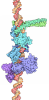
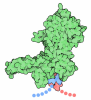
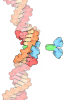
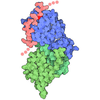
| Title | Trident submodule from human SRCAP-nucleosome complex in the fully-engaged state (focused refinement) | |||||||||||||||||||||||||||
 Components Components |
| |||||||||||||||||||||||||||
 Keywords Keywords | GENE REGULATION / Chromatin Remodeler / Snf2 family ATPase / H2A.Z | |||||||||||||||||||||||||||
| Function / homology |  Function and homology information Function and homology informationnpBAF complex / brahma complex / positive regulation of telomere maintenance in response to DNA damage / regulation of DNA strand elongation / GBAF complex / histone chaperone activity / neural retina development / Formation of the embryonic stem cell BAF (esBAF) complex / Formation of the canonical BAF (cBAF) complex / RSC-type complex ...npBAF complex / brahma complex / positive regulation of telomere maintenance in response to DNA damage / regulation of DNA strand elongation / GBAF complex / histone chaperone activity / neural retina development / Formation of the embryonic stem cell BAF (esBAF) complex / Formation of the canonical BAF (cBAF) complex / RSC-type complex / Formation of the polybromo-BAF (pBAF) complex / Swr1 complex / Formation of neuronal progenitor and neuronal BAF (npBAF and nBAF) / Formation of the non-canonical BAF (ncBAF) complex / regulation of G0 to G1 transition / Ino80 complex / regulation of double-strand break repair / SWI/SNF complex / ATP-dependent chromatin remodeler activity / spinal cord development / positive regulation of T cell differentiation / regulation of mitotic metaphase/anaphase transition / regulation of nucleotide-excision repair / positive regulation of stem cell population maintenance / NuA4 histone acetyltransferase complex / regulation of chromosome organization / positive regulation of double-strand break repair / Regulation of MITF-M-dependent genes involved in pigmentation / negative regulation of cell differentiation / RUNX1 interacts with co-factors whose precise effect on RUNX1 targets is not known / regulation of DNA replication / positive regulation of myoblast differentiation / cAMP/PKA signal transduction / positive regulation of double-strand break repair via homologous recombination / regulation of G1/S transition of mitotic cell cycle / regulation of embryonic development / telomere maintenance / transcription initiation-coupled chromatin remodeling / positive regulation of cell differentiation / Regulation of endogenous retroelements by Piwi-interacting RNAs (piRNAs) / kinetochore / DNA Damage Recognition in GG-NER / Hydrolases; Acting on acid anhydrides; Acting on acid anhydrides to facilitate cellular and subcellular movement / nuclear matrix / RMTs methylate histone arginines / nervous system development / nucleosome / UCH proteinases / histone binding / HATs acetylate histones / regulation of cell cycle / nuclear body / regulation of apoptotic process / transcription coactivator activity / nuclear speck / chromatin remodeling / chromatin binding / regulation of transcription by RNA polymerase II / positive regulation of cell population proliferation / regulation of DNA-templated transcription / positive regulation of DNA-templated transcription / chromatin / negative regulation of transcription by RNA polymerase II / perinuclear region of cytoplasm / signal transduction / positive regulation of transcription by RNA polymerase II / ATP hydrolysis activity / protein-containing complex / DNA binding / nucleoplasm / ATP binding / nucleus / plasma membrane Similarity search - Function | |||||||||||||||||||||||||||
| Biological species |  Homo sapiens (human) Homo sapiens (human)synthetic construct (others) | |||||||||||||||||||||||||||
| Method | ELECTRON MICROSCOPY / single particle reconstruction / cryo EM / Resolution: 3.8 Å | |||||||||||||||||||||||||||
 Authors Authors | Louder, R.K. / Park, G. | |||||||||||||||||||||||||||
| Funding support |  United States, 1items United States, 1items
| |||||||||||||||||||||||||||
 Citation Citation | Journal: Sci Adv / Year: 2026 Title: Structural mechanism of histone H2A.Z exchange by human SRCAP-CFDP1 holoenzyme. Authors: Giho Park / Carl Wu / Robert K Louder / Abstract: The conserved yeast SWR1 and human SRCAP chromatin remodeling complexes catalyze exchange of nucleosomal histone H2A for H2A.Z, but the underlying mechanism has remained obscure. Here, we show that ...The conserved yeast SWR1 and human SRCAP chromatin remodeling complexes catalyze exchange of nucleosomal histone H2A for H2A.Z, but the underlying mechanism has remained obscure. Here, we show that histone exchange by SRCAP requires the transient activator CFDP1 and resolve nine cryo-electron microscopy structures of the SRCAP-CFDP1 holoenzyme that define the stepwise exchange mechanism. CFDP1 recognizes the conformation of the fully engaged SRCAP-nucleosome complex through interactions with multiple subunits-including direct contact with the ATPase domain-and induces conformational transitions that drive extensive DNA unwrapping, eviction of the H2A-H2B dimer, and insertion of the H2A.Z-H2B dimer, all without necessarily requiring hydrolysis of bound ATP. Collectively, these findings provide unprecedented insight into the mechanism of activator- and nucleotide-driven histone exchange from nucleosomal H2A to H2A.Z. | |||||||||||||||||||||||||||
| History |
|
- Structure visualization
| Structure viewer | Molecule: MolmilJmol/JSmol |
|---|
- Downloads & links
-Download
| PDBx/mmCIF format | 9pgc.cif.gz | 327.7 KB | Display | PDBx/mmCIF format |
|---|---|---|---|---|
| PDB format | pdb9pgc.ent.gz | 184.5 KB | Display | PDB format |
| PDBx/mmJSON format | 9pgc.json.gz | Tree view | PDBx/mmJSON format | |
| Others |  Other downloads Other downloads |
-Validation report
| Arichive directory | https://data.pdbj.org/pub/pdb/validation_reports/pg/9pgcftp://data.pdbj.org/pub/pdb/validation_reports/pg/9pgc | HTTPS FTP |
|---|
-Related structure data
| Related structure data |  71625MC  9ca7C  9ca8C  9ca9C  9caaC  9nfvC  9nfwC  9nfxC  9nfyC  9nfzC  9ng0C  9pgdC  9y3dC  9y3eC  9y3fC  9y3gC  9y3hC  9zlaC C: citing same article ( M: map data used to model this data |
|---|---|
| Similar structure data |


-Links
 PDBj
PDBj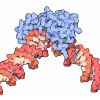

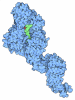
- Assembly
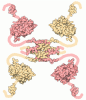
| Deposited unit | 
|
|---|---|
| 1 |
|
-Components
-Protein , 3 types, 3 molecules ABK
| #1: Protein | Mass: 343915.250 Da / Num. of mol.: 1 / Source method: isolated from a natural source / Source: (natural) Homo sapiens (human) / Cell line: K-562 / Organ: BLOOD / Tissue: BONE MARROWReferences: UniProt: Q6ZRS2, Hydrolases; Acting on acid anhydrides; Acting on acid anhydrides to facilitate cellular and subcellular movement |
|---|---|
| #2: Protein | Mass: 40658.363 Da / Num. of mol.: 1 / Source method: isolated from a natural source / Source: (natural) Homo sapiens (human) / Cell line: K-562 / Organ: BLOOD / Tissue: BONE MARROW / References: UniProt: Q15906 |
| #3: Protein | Mass: 47509.812 Da / Num. of mol.: 1 / Source method: isolated from a natural source / Source: (natural) Homo sapiens (human) / Cell line: K-562 / Organ: BLOOD / Tissue: BONE MARROW / References: UniProt: O96019 |
-DNA chain , 2 types, 2 molecules YZ
| #4: DNA chain | Mass: 87851.664 Da / Num. of mol.: 1 / Source method: obtained synthetically / Source: (synth.) synthetic construct (others) |
|---|---|
| #5: DNA chain | Mass: 88190.930 Da / Num. of mol.: 1 / Source method: obtained synthetically / Source: (synth.) synthetic construct (others) |
-Non-polymers , 2 types, 4 molecules 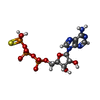

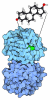
| #6: Chemical | 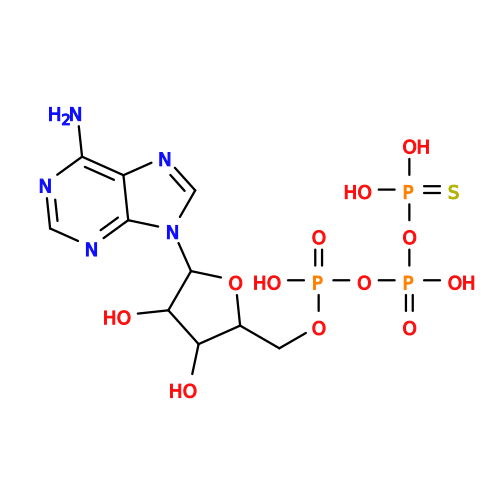 Mass: 523.247 Da / Num. of mol.: 2 / Source method: obtained synthetically / Formula: C10H16N5O12P3S / Comment: ATP-gamma-S, energy-carrying molecule analogue*YM Mass: 523.247 Da / Num. of mol.: 2 / Source method: obtained synthetically / Formula: C10H16N5O12P3S / Comment: ATP-gamma-S, energy-carrying molecule analogue*YM#7: Chemical |  Mass: 24.305 Da / Num. of mol.: 2 / Source method: obtained synthetically / Formula: Mg Mass: 24.305 Da / Num. of mol.: 2 / Source method: obtained synthetically / Formula: Mg |
|---|
-Details
| Has ligand of interest | N |
|---|---|
| Has protein modification | N |
-Experimental details
-Experiment
| Experiment | Method: ELECTRON MICROSCOPY |
|---|---|
| EM experiment | Aggregation state: PARTICLE / 3D reconstruction method: single particle reconstruction |
- Sample preparation
| Component |
| |||||||||||||||||||||
|---|---|---|---|---|---|---|---|---|---|---|---|---|---|---|---|---|---|---|---|---|---|---|
| Molecular weight | Experimental value: NO | |||||||||||||||||||||
| Source (natural) | Organism: Homo sapiens (human) / Strain: K-562 / Cellular location: NUCLEOPLASM / Organ: BLOOD / Organelle: NUCLEUS / Tissue: BONE MARROW | |||||||||||||||||||||
| Buffer solution | pH: 7.6 | |||||||||||||||||||||
| Specimen | Embedding applied: NO / Shadowing applied: NO / Staining applied: NO / Vitrification applied: YES | |||||||||||||||||||||
| Vitrification | Cryogen name: ETHANE |
- Electron microscopy imaging
| Experimental equipment |  Model: Titan Krios / Image courtesy: FEI Company |
|---|---|
| Microscopy | Model: TFS KRIOS |
| Electron gun | Electron source:  FIELD EMISSION GUN / Accelerating voltage: 300 kV / Illumination mode: FLOOD BEAM FIELD EMISSION GUN / Accelerating voltage: 300 kV / Illumination mode: FLOOD BEAM |
| Electron lens | Mode: BRIGHT FIELD / Nominal defocus max: 1600 nm / Nominal defocus min: 800 nm |
| Image recording | Electron dose: 50 e/Å2 / Film or detector model: GATAN K3 (6k x 4k) |
- Processing
| EM software |
| ||||||||||||||||||||||||
|---|---|---|---|---|---|---|---|---|---|---|---|---|---|---|---|---|---|---|---|---|---|---|---|---|---|
| CTF correction | Type: PHASE FLIPPING AND AMPLITUDE CORRECTION | ||||||||||||||||||||||||
| 3D reconstruction | Resolution: 3.8 Å / Resolution method: FSC 0.143 CUT-OFF / Num. of particles: 57610 / Symmetry type: POINT | ||||||||||||||||||||||||
| Refinement | Cross valid method: NONE Stereochemistry target values: GeoStd + Monomer Library + CDL v1.2 | ||||||||||||||||||||||||
| Displacement parameters | Biso mean: 120 Å2 | ||||||||||||||||||||||||
| Refine LS restraints |
|
