 Movie
Movie Controller


+ Open data

- Basic information
| Entry | Database: PDB / ID: 6eny | ||||||||||||
|---|---|---|---|---|---|---|---|---|---|---|---|---|---|
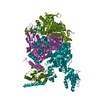
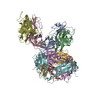
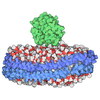
| Title | Structure of the human PLC editing module | ||||||||||||
 Components Components |
| ||||||||||||
 Keywords Keywords | IMMUNE SYSTEM / adaptive immunity / antigen processing / chaperone / MHC class I | ||||||||||||
| Function / homology |  Function and homology information Function and homology informationMHC class Ib protein complex assembly / peptide antigen stabilization / response to biphenyl / negative regulation of intracellular steroid hormone receptor signaling pathway / Calnexin/calreticulin cycle / MHC class I protein complex binding / cytolytic granule / nuclear receptor-mediated glucocorticoid signaling pathway / positive regulation of dendritic cell chemotaxis / Assembly of Viral Components at the Budding Site ...MHC class Ib protein complex assembly / peptide antigen stabilization / response to biphenyl / negative regulation of intracellular steroid hormone receptor signaling pathway / Calnexin/calreticulin cycle / MHC class I protein complex binding / cytolytic granule / nuclear receptor-mediated glucocorticoid signaling pathway / positive regulation of dendritic cell chemotaxis / Assembly of Viral Components at the Budding Site / ATF6 (ATF6-alpha) activates chaperone genes / protein disulfide-isomerase / cellular response to electrical stimulus / negative regulation of trophoblast cell migration / negative regulation of retinoic acid receptor signaling pathway / cortical granule / response to peptide / complement component C1q complex binding / endoplasmic reticulum quality control compartment / sarcoplasmic reticulum lumen / protein folding in endoplasmic reticulum / cellular response to lithium ion / disulfide oxidoreductase activity / nuclear export signal receptor activity / TAP2 binding / regulation of protein complex stability / TAP1 binding / cardiac muscle cell differentiation / C-type glycerophospholipase activity / response to glycoside / negative regulation of neuron differentiation / positive regulation of memory T cell activation / T cell mediated cytotoxicity directed against tumor cell target / positive regulation of CD8-positive, alpha-beta T cell activation / CD8-positive, alpha-beta T cell activation / positive regulation of CD8-positive, alpha-beta T cell proliferation / T cell mediated cytotoxicity / Scavenging by Class A Receptors / Scavenging by Class F Receptors / nuclear androgen receptor binding / antigen processing and presentation of endogenous peptide antigen via MHC class I via ER pathway, TAP-dependent / response to testosterone / TAP complex binding / antigen processing and presentation of exogenous peptide antigen via MHC class I / Golgi medial cisterna / retrograde vesicle-mediated transport, Golgi to endoplasmic reticulum / protein disulfide isomerase activity / lncRNA binding / CD8 receptor binding / smooth endoplasmic reticulum / protection from natural killer cell mediated cytotoxicity / hormone binding / protein-disulfide reductase activity / TAP binding / endoplasmic reticulum exit site / protein localization to nucleus / MHC class I protein binding / positive regulation of substrate adhesion-dependent cell spreading / detection of bacterium / antigen processing and presentation of endogenous peptide antigen via MHC class Ib / antigen processing and presentation of endogenous peptide antigen via MHC class I via ER pathway, TAP-independent / molecular sequestering activity / protein export from nucleus / beta-2-microglobulin binding / T cell receptor binding / endocytic vesicle lumen / peptide binding / ERAD pathway / phagocytic vesicle / endoplasmic reticulum-Golgi intermediate compartment membrane / positive regulation of cell cycle / positive regulation of endothelial cell migration / protein folding chaperone / positive regulation of phagocytosis / acrosomal vesicle / response to endoplasmic reticulum stress / regulation of natural killer cell mediated immunity / early endosome lumen / positive regulation of T cell mediated cytotoxicity / Nef mediated downregulation of MHC class I complex cell surface expression / DAP12 interactions / Endosomal/Vacuolar pathway / Antigen Presentation: Folding, assembly and peptide loading of class I MHC / lumenal side of endoplasmic reticulum membrane / regulation of iron ion transport / cellular response to virus / protein maturation / Maturation of DENV proteins / negative regulation of iron ion transport / negative regulation of forebrain neuron differentiation / antigen processing and presentation of exogenous peptide antigen via MHC class Ib / peptide antigen assembly with MHC class I protein complex / ER to Golgi transport vesicle membrane / HFE-transferrin receptor complex / positive regulation of type II interferon production / MHC class I peptide loading complex / transferrin transport / negative regulation of receptor-mediated endocytosis / cellular response to iron ion / positive regulation of T cell cytokine production Similarity search - Function | ||||||||||||
| Biological species |  Homo sapiens (human) Homo sapiens (human) | ||||||||||||
| Method | ELECTRON MICROSCOPY / single particle reconstruction / cryo EM / Resolution: 5.8 Å | ||||||||||||
 Authors Authors | Trowitzsch, S. / Januliene, D. / Blees, A. / Moeller, A. / Tampe, R. | ||||||||||||
| Funding support |  Germany, 2items Germany, 2items
| ||||||||||||
 Citation Citation | Journal: Nature / Year: 2017 Title: Structure of the human MHC-I peptide-loading complex. Authors: Andreas Blees / Dovile Januliene / Tommy Hofmann / Nicole Koller / Carla Schmidt / Simon Trowitzsch / Arne Moeller / Robert Tampé / Abstract: The peptide-loading complex (PLC) is a transient, multisubunit membrane complex in the endoplasmic reticulum that is essential for establishing a hierarchical immune response. The PLC coordinates ...The peptide-loading complex (PLC) is a transient, multisubunit membrane complex in the endoplasmic reticulum that is essential for establishing a hierarchical immune response. The PLC coordinates peptide translocation into the endoplasmic reticulum with loading and editing of major histocompatibility complex class I (MHC-I) molecules. After final proofreading in the PLC, stable peptide-MHC-I complexes are released to the cell surface to evoke a T-cell response against infected or malignant cells. Sampling of different MHC-I allomorphs requires the precise coordination of seven different subunits in a single macromolecular assembly, including the transporter associated with antigen processing (TAP1 and TAP2, jointly referred to as TAP), the oxidoreductase ERp57, the MHC-I heterodimer, and the chaperones tapasin and calreticulin. The molecular organization of and mechanistic events that take place in the PLC are unknown owing to the heterogeneous composition and intrinsically dynamic nature of the complex. Here, we isolate human PLC from Burkitt's lymphoma cells using an engineered viral inhibitor as bait and determine the structure of native PLC by electron cryo-microscopy. Two endoplasmic reticulum-resident editing modules composed of tapasin, calreticulin, ERp57, and MHC-I are centred around TAP in a pseudo-symmetric orientation. A multivalent chaperone network within and across the editing modules establishes the proofreading function at two lateral binding platforms for MHC-I molecules. The lectin-like domain of calreticulin senses the MHC-I glycan, whereas the P domain reaches over the MHC-I peptide-binding pocket towards ERp57. This arrangement allows tapasin to facilitate peptide editing by clamping MHC-I. The translocation pathway of TAP opens out into a large endoplasmic reticulum lumenal cavity, confined by the membrane entry points of tapasin and MHC-I. Two lateral windows channel the antigenic peptides to MHC-I. Structures of PLC captured at distinct assembly states provide mechanistic insight into the recruitment and release of MHC-I. Our work defines the molecular symbiosis of an ABC transporter and an endoplasmic reticulum chaperone network in MHC-I assembly and provides insight into the onset of the adaptive immune response. | ||||||||||||
| History |
|
- Structure visualization
| Movie |
Movie viewer |
|---|---|
| Structure viewer | Molecule: MolmilJmol/JSmol |
- Downloads & links
-Download
| PDBx/mmCIF format | 6eny.cif.gz | 257.1 KB | Display | PDBx/mmCIF format |
|---|---|---|---|---|
| PDB format | pdb6eny.ent.gz | 168 KB | Display | PDB format |
| PDBx/mmJSON format | 6eny.json.gz | Tree view | PDBx/mmJSON format | |
| Others |  Other downloads Other downloads |
-Validation report
| Arichive directory | https://data.pdbj.org/pub/pdb/validation_reports/en/6enyftp://data.pdbj.org/pub/pdb/validation_reports/en/6eny | HTTPS FTP |
|---|
-Related structure data
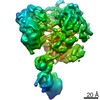
| Related structure data | 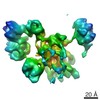 3906MC  3904C 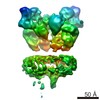 3905C M: map data used to model this data C: citing same article ( |
|---|---|
| Similar structure data |


-Links
 PDBj
PDBj

- Assembly
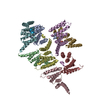
| Deposited unit | 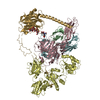
|
|---|---|
| 1 |
|
-Components
-Protein , 5 types, 5 molecules BCDFG
| #1: Protein | Mass: 11748.160 Da / Num. of mol.: 1 / Source method: isolated from a natural source / Source: (natural) Homo sapiens (human) / References: UniProt: P61769 |
|---|---|
| #2: Protein | Mass: 45761.184 Da / Num. of mol.: 1 / Source method: isolated from a natural source / Source: (natural) Homo sapiens (human) / References: UniProt: O15533 |
| #3: Protein | Mass: 54341.102 Da / Num. of mol.: 1 / Source method: isolated from a natural source / Source: (natural) Homo sapiens (human) / References: UniProt: P30101, protein disulfide-isomerase |
| #4: Protein | Mass: 38363.535 Da / Num. of mol.: 1 / Source method: isolated from a natural source / Source: (natural) Homo sapiens (human) / References: UniProt: P04439 |
| #5: Protein | Mass: 46507.145 Da / Num. of mol.: 1 / Source method: isolated from a natural source / Source: (natural) Homo sapiens (human) / References: UniProt: P27797 |
-Sugars , 2 types, 2 molecules
| #6: Polysaccharide | 2-acetamido-2-deoxy-beta-D-glucopyranose-(1-4)-2-acetamido-2-deoxy-beta-D-glucopyranose Source method: isolated from a genetically manipulated source |
|---|---|
| #7: Polysaccharide | beta-D-glucopyranose-(1-3)-alpha-D-mannopyranose-(1-2)-alpha-D-mannopyranose-(1-2)-alpha-D-mannopyranose Type: oligosaccharide / Mass: 666.578 Da / Num. of mol.: 1 Source method: isolated from a genetically manipulated source |
-Experimental details
-Experiment
| Experiment | Method: ELECTRON MICROSCOPY |
|---|---|
| EM experiment | Aggregation state: PARTICLE / 3D reconstruction method: single particle reconstruction |
- Sample preparation
| Component | Name: Protein Complex / Type: COMPLEX / Entity ID: #1-#5 / Source: NATURAL |
|---|---|
| Molecular weight | Experimental value: NO |
| Source (natural) | Organism: Homo sapiens (human) |
| Buffer solution | pH: 7.5 |
| Specimen | Conc.: 2 mg/ml / Embedding applied: NO / Shadowing applied: NO / Staining applied: NO / Vitrification applied: YES |
| Specimen support | Grid type: C-flat-2/2 |
| Vitrification | Instrument: FEI VITROBOT MARK IV / Cryogen name: ETHANE / Humidity: 100 % / Chamber temperature: 277 K |
- Electron microscopy imaging
| Experimental equipment |  Model: Titan Krios / Image courtesy: FEI Company |
|---|---|
| Microscopy | Model: FEI TITAN KRIOS |
| Electron gun | Electron source:  FIELD EMISSION GUN / Accelerating voltage: 300 kV / Illumination mode: FLOOD BEAM FIELD EMISSION GUN / Accelerating voltage: 300 kV / Illumination mode: FLOOD BEAM |
| Electron lens | Mode: BRIGHT FIELD |
| Image recording | Electron dose: 55 e/Å2 / Detector mode: COUNTING / Film or detector model: GATAN K2 QUANTUM (4k x 4k) |
- Processing
| EM software |
| ||||||||||||||||||||||||||||||||||||
|---|---|---|---|---|---|---|---|---|---|---|---|---|---|---|---|---|---|---|---|---|---|---|---|---|---|---|---|---|---|---|---|---|---|---|---|---|---|
| CTF correction | Details: CTF correction was performed internally in Relion and Frealign Type: NONE | ||||||||||||||||||||||||||||||||||||
| Symmetry | Point symmetry: C1 (asymmetric) | ||||||||||||||||||||||||||||||||||||
| 3D reconstruction | Resolution: 5.8 Å / Resolution method: FSC 0.143 CUT-OFF / Num. of particles: 141078 / Symmetry type: POINT | ||||||||||||||||||||||||||||||||||||
| Refinement | Highest resolution: 5.8 Å |
