 Movie
Movie Controller

[English] 日本語
 Yorodumi
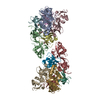
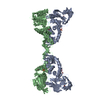
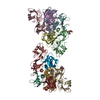
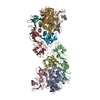
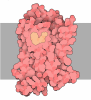
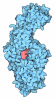
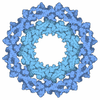
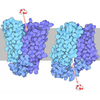
- PDB-6u9v: Cryo electron microscopy structure of the ATP-gated rat P2X7 ion ... -
+ Open data

- Basic information
| Entry | Database: PDB / ID: 6u9v | ||||||||||||
|---|---|---|---|---|---|---|---|---|---|---|---|---|---|
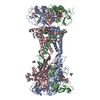
| Title | Cryo electron microscopy structure of the ATP-gated rat P2X7 ion channel in the apo, closed state | ||||||||||||
 Components Components | P2X purinoceptor 7 | ||||||||||||
 Keywords Keywords | MEMBRANE PROTEIN / Ion Channel Apoptosis | ||||||||||||
| Function / homology |  Function and homology information Function and homology informationPlatelet homeostasis / The NLRP3 inflammasome / NAD transport / positive regulation of lymphocyte apoptotic process / phospholipid transfer to membrane / regulation of presynaptic dense core granule exocytosis / positive regulation of bleb assembly / phagolysosome assembly / Elevation of cytosolic Ca2+ levels / positive regulation of cytoskeleton organization ...Platelet homeostasis / The NLRP3 inflammasome / NAD transport / positive regulation of lymphocyte apoptotic process / phospholipid transfer to membrane / regulation of presynaptic dense core granule exocytosis / positive regulation of bleb assembly / phagolysosome assembly / Elevation of cytosolic Ca2+ levels / positive regulation of cytoskeleton organization / positive regulation of interleukin-1 alpha production / positive regulation of monoatomic ion transmembrane transport / plasma membrane phospholipid scrambling / plasma membrane organization / purinergic nucleotide receptor signaling pathway / collagen metabolic process / positive regulation of prostaglandin secretion / bleb assembly / extracellularly ATP-gated monoatomic cation channel activity / ATP export / purinergic nucleotide receptor activity / positive regulation of catalytic activity / pore complex assembly / negative regulation of cell volume / positive regulation of gamma-aminobutyric acid secretion / vesicle budding from membrane / programmed cell death / response to fluid shear stress / bleb / ceramide biosynthetic process / skeletal system morphogenesis / T cell proliferation / negative regulation of bone resorption / positive regulation of mitochondrial depolarization / cell volume homeostasis / homeostasis of number of cells within a tissue / T cell homeostasis / positive regulation of ossification / cellular response to dsRNA / phospholipid translocation / response to zinc ion / response to ATP / positive regulation of bone mineralization / positive regulation of glutamate secretion / sodium channel activity / protein homotrimerization / positive regulation of MAP kinase activity / regulation of sodium ion transport / membrane protein ectodomain proteolysis / synaptic vesicle exocytosis / positive regulation of calcium ion transport into cytosol / neuronal action potential / response to electrical stimulus / reactive oxygen species metabolic process / positive regulation of NLRP3 inflammasome complex assembly / membrane depolarization / potassium channel activity / response to mechanical stimulus / response to bacterium / extrinsic apoptotic signaling pathway / monoatomic cation transport / cell morphogenesis / negative regulation of MAPK cascade / release of sequestered calcium ion into cytosol / sensory perception of pain / apoptotic signaling pathway / positive regulation of glycolytic process / protein serine/threonine kinase activator activity / gene expression / positive regulation of T cell mediated cytotoxicity / positive regulation of protein secretion / positive regulation of interleukin-1 beta production / positive regulation of cytokine production / mitochondrion organization / neuromuscular junction / lipopolysaccharide binding / protein processing / protein catabolic process / response to calcium ion / positive regulation of interleukin-6 production / positive regulation of protein phosphorylation / calcium ion transmembrane transport / calcium ion transport / terminal bouton / cell-cell junction / nuclear envelope / signaling receptor activity / response to lipopolysaccharide / channel activity / scaffold protein binding / protein phosphorylation / positive regulation of MAPK cascade / inflammatory response / cell surface receptor signaling pathway / postsynapse / defense response to Gram-positive bacterium / response to xenobiotic stimulus / positive regulation of apoptotic process / copper ion binding / external side of plasma membrane Similarity search - Function | ||||||||||||
| Biological species |   Rattus norvegicus (Norway rat) Rattus norvegicus (Norway rat) | ||||||||||||
| Method | ELECTRON MICROSCOPY / single particle reconstruction / cryo EM / Resolution: 2.9 Å | ||||||||||||
 Authors Authors | Mansoor, S.E. / McCarthy, A.E. | ||||||||||||
| Funding support |  United States, 1items United States, 1items
| ||||||||||||
 Citation Citation | Journal: Cell / Year: 2019 Title: Full-Length P2X Structures Reveal How Palmitoylation Prevents Channel Desensitization. Authors: Alanna E McCarthy / Craig Yoshioka / Steven E Mansoor / Abstract: P2X receptors are trimeric, non-selective cation channels activated by extracellular ATP. The P2X receptor subtype is a pharmacological target because of involvement in apoptotic, inflammatory, and ...P2X receptors are trimeric, non-selective cation channels activated by extracellular ATP. The P2X receptor subtype is a pharmacological target because of involvement in apoptotic, inflammatory, and tumor progression pathways. It is the most structurally and functionally distinct P2X subtype, containing a unique cytoplasmic domain critical for the receptor to initiate apoptosis and not undergo desensitization. However, lack of structural information about the cytoplasmic domain has hindered understanding of the molecular mechanisms underlying these processes. We report cryoelectron microscopy structures of full-length rat P2X receptor in apo and ATP-bound states. These structures reveal how one cytoplasmic element, the C-cys anchor, prevents desensitization by anchoring the pore-lining helix to the membrane with palmitoyl groups. They show a second cytoplasmic element with a unique fold, the cytoplasmic ballast, which unexpectedly contains a zinc ion complex and a guanosine nucleotide binding site. Our structures provide first insights into the architecture and function of a P2X receptor cytoplasmic domain. | ||||||||||||
| History |
|
- Structure visualization
| Movie |
Movie viewer |
|---|---|
| Structure viewer | Molecule: MolmilJmol/JSmol |
- Downloads & links
-Download
| PDBx/mmCIF format | 6u9v.cif.gz | 580.2 KB | Display | PDBx/mmCIF format |
|---|---|---|---|---|
| PDB format | pdb6u9v.ent.gz | 489.3 KB | Display | PDB format |
| PDBx/mmJSON format | 6u9v.json.gz | Tree view | PDBx/mmJSON format | |
| Others |  Other downloads Other downloads |
-Validation report
| Arichive directory | https://data.pdbj.org/pub/pdb/validation_reports/u9/6u9vftp://data.pdbj.org/pub/pdb/validation_reports/u9/6u9v | HTTPS FTP |
|---|
-Related structure data
| Related structure data |  20702MC  6u9wC M: map data used to model this data C: citing same article ( |
|---|---|
| Similar structure data |

-Links
 PDBj
PDBj
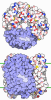
- Assembly
| Deposited unit | 
|
|---|---|
| 1 |
|
-Components
-Protein , 1 types, 3 molecules ABC
| #1: Protein | Mass: 69904.016 Da / Num. of mol.: 3 Source method: isolated from a genetically manipulated source Source: (gene. exp.) Rattus norvegicus (Norway rat) / Gene: P2rx7 / Production host:  Homo sapiens (human) / References: UniProt: Q64663 Homo sapiens (human) / References: UniProt: Q64663 |
|---|
-Sugars , 3 types, 18 molecules 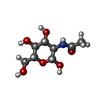
| #2: Polysaccharide | 2-acetamido-2-deoxy-beta-D-glucopyranose-(1-4)-2-acetamido-2-deoxy-beta-D-glucopyranose Source method: isolated from a genetically manipulated source #3: Polysaccharide | 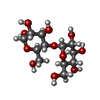 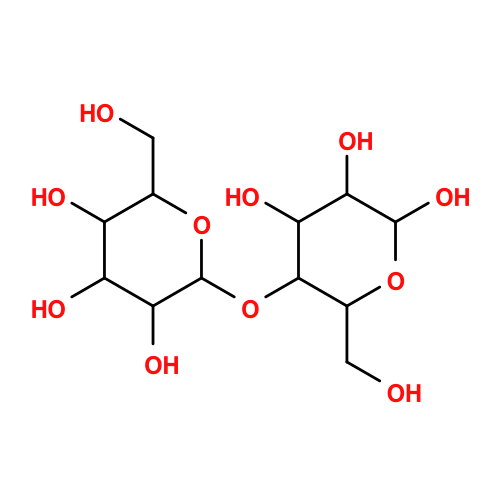 Source method: isolated from a genetically manipulated source Details: oligosaccharide / References: alpha-maltose #6: Sugar | ChemComp-NAG / 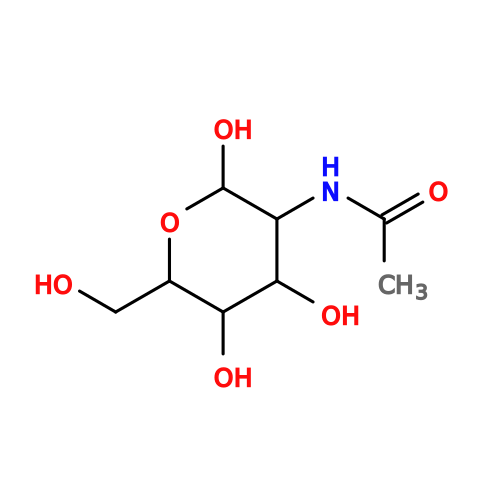 Type: D-saccharide, beta linking / Mass: 221.208 Da / Num. of mol.: 9 Type: D-saccharide, beta linking / Mass: 221.208 Da / Num. of mol.: 9Source method: isolated from a genetically manipulated source Formula: C8H15NO6 |
|---|
-Non-polymers , 4 types, 30 molecules 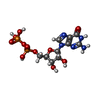

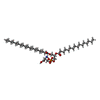
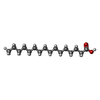
| #4: Chemical | 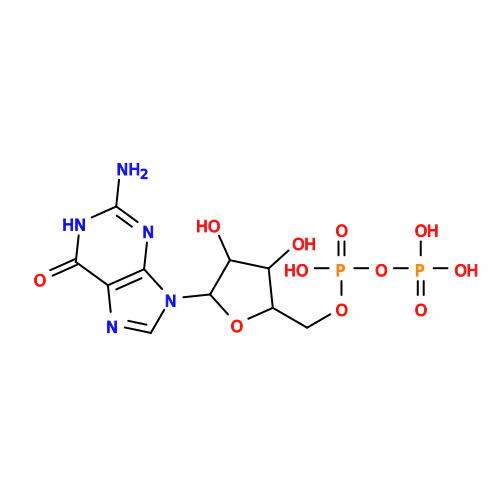 Type: RNA linking / Mass: 443.201 Da / Num. of mol.: 3 / Source method: obtained synthetically / Formula: C10H15N5O11P2 / Feature type: SUBJECT OF INVESTIGATION / Comment: GDP, energy-carrying molecule*YM Type: RNA linking / Mass: 443.201 Da / Num. of mol.: 3 / Source method: obtained synthetically / Formula: C10H15N5O11P2 / Feature type: SUBJECT OF INVESTIGATION / Comment: GDP, energy-carrying molecule*YM#5: Chemical | ChemComp-ZN /  Mass: 65.409 Da / Num. of mol.: 6 / Source method: obtained synthetically / Formula: Zn / Feature type: SUBJECT OF INVESTIGATION Mass: 65.409 Da / Num. of mol.: 6 / Source method: obtained synthetically / Formula: Zn / Feature type: SUBJECT OF INVESTIGATION#7: Chemical |  Mass: 764.022 Da / Num. of mol.: 3 / Source method: obtained synthetically / Formula: C40H78NO10P / Comment: phospholipid*YM Mass: 764.022 Da / Num. of mol.: 3 / Source method: obtained synthetically / Formula: C40H78NO10P / Comment: phospholipid*YM#8: Chemical | ChemComp-PLM / 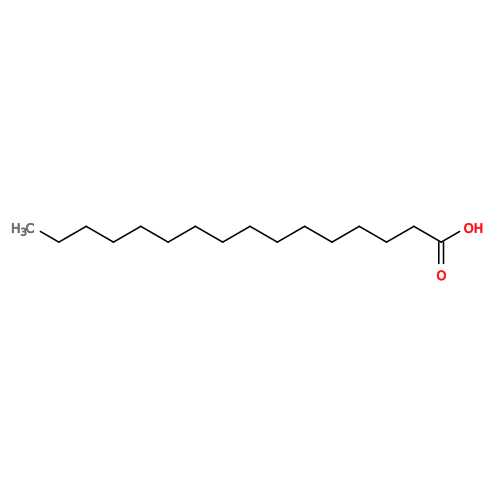 Mass: 256.424 Da / Num. of mol.: 18 / Source method: obtained synthetically / Formula: C16H32O2 Mass: 256.424 Da / Num. of mol.: 18 / Source method: obtained synthetically / Formula: C16H32O2 |
|---|
-Details
| Has ligand of interest | Y |
|---|---|
| Has protein modification | Y |
-Experimental details
-Experiment
| Experiment | Method: ELECTRON MICROSCOPY |
|---|---|
| EM experiment | Aggregation state: PARTICLE / 3D reconstruction method: single particle reconstruction |
- Sample preparation
| Component | Name: P2X7 receptor ion channel / Type: COMPLEX / Entity ID: #1 / Source: RECOMBINANT |
|---|---|
| Molecular weight | Experimental value: NO |
| Source (natural) | Organism: Rattus norvegicus (Norway rat) |
| Source (recombinant) | Organism: Homo sapiens (human) |
| Buffer solution | pH: 7 |
| Specimen | Embedding applied: NO / Shadowing applied: NO / Staining applied: NO / Vitrification applied: YES |
| Specimen support | Details: unspecified |
| Vitrification | Cryogen name: ETHANE |
- Electron microscopy imaging
| Experimental equipment |  Model: Titan Krios / Image courtesy: FEI Company |
|---|---|
| Microscopy | Model: FEI TITAN KRIOS |
| Electron gun | Electron source:  FIELD EMISSION GUN / Accelerating voltage: 300 kV / Illumination mode: FLOOD BEAM FIELD EMISSION GUN / Accelerating voltage: 300 kV / Illumination mode: FLOOD BEAM |
| Electron lens | Mode: BRIGHT FIELD |
| Image recording | Electron dose: 27 e/Å2 / Film or detector model: FEI FALCON III (4k x 4k) |
- Processing
| CTF correction | Type: PHASE FLIPPING ONLY |
|---|---|
| 3D reconstruction | Resolution: 2.9 Å / Resolution method: FSC 0.143 CUT-OFF / Num. of particles: 77697 / Symmetry type: POINT |
