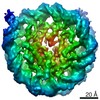
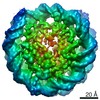
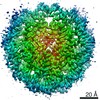
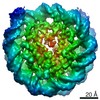
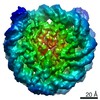
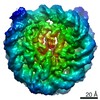
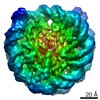
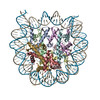
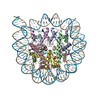
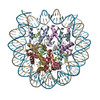
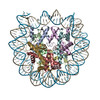
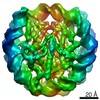
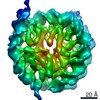
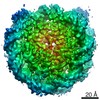
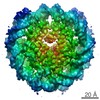
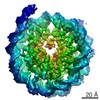
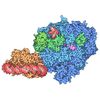
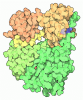
- EMDB-10152: CENP-A nucleosome in complex with CENP-C central region -
+
データを開く
IDまたはキーワード:
読み込み中...
-
基本情報
登録情報
データベース: EMDB / ID: EMD-10152
タイトル
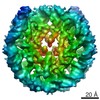
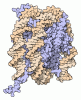
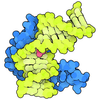
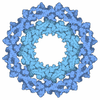
CENP-A nucleosome in complex with CENP-C central region
マップデータ
CENP-A nucleosome in complex with CENP-C central region
試料
複合体: CENP-A nucleosome
複合体: Histones
タンパク質・ペプチド: Histone H3-like centromeric protein A
タンパク質・ペプチド: Histone H4
タンパク質・ペプチド: Histone H2A type 2-A
タンパク質・ペプチド: Histone H2B type 1-C/E/F/G/I
タンパク質・ペプチド: Centromere protein C
複合体: DNA
DNA: DNA (145-MER)
DNA: DNA (145-MER)
キーワード
CENP-A / nucleosome / CCAN / CENP-C / NUCLEAR PROTEIN
機能・相同性
機能・相同性情報
spindle attachment to meiosis I kinetochore / centromeric DNA binding / CENP-A containing chromatin assembly / protein localization to chromosome, centromeric region / kinetochore assembly / condensed chromosome, centromeric region / attachment of mitotic spindle microtubules to kinetochore / inner kinetochore / establishment of mitotic spindle orientation / mitotic cytokinesis ...spindle attachment to meiosis I kinetochore / centromeric DNA binding / CENP-A containing chromatin assembly / protein localization to chromosome, centromeric region / kinetochore assembly / condensed chromosome, centromeric region / attachment of mitotic spindle microtubules to kinetochore / inner kinetochore / establishment of mitotic spindle orientation / mitotic cytokinesis / chromosome, centromeric region / pericentric heterochromatin / negative regulation of megakaryocyte differentiation / protein localization to CENP-A containing chromatin / Replacement of protamines by nucleosomes in the male pronucleus / CENP-A containing nucleosome / Packaging Of Telomere Ends / Amplification of signal from unattached kinetochores via a MAD2 inhibitory signal / Recognition and association of DNA glycosylase with site containing an affected purine / Cleavage of the damaged purine / Deposition of new CENPA-containing nucleosomes at the centromere / Mitotic Prometaphase / telomere organization / EML4 and NUDC in mitotic spindle formation / Recognition and association of DNA glycosylase with site containing an affected pyrimidine / Cleavage of the damaged pyrimidine / RNA Polymerase I Promoter Opening / Inhibition of DNA recombination at telomere / Assembly of the ORC complex at the origin of replication / Meiotic synapsis / SUMOylation of chromatin organization proteins / Regulation of endogenous retroelements by the Human Silencing Hub (HUSH) complex / Resolution of Sister Chromatid Cohesion / DNA methylation / Condensation of Prophase Chromosomes / Chromatin modifications during the maternal to zygotic transition (MZT) / SIRT1 negatively regulates rRNA expression / HCMV Late Events / ERCC6 (CSB) and EHMT2 (G9a) positively regulate rRNA expression / PRC2 methylates histones and DNA / innate immune response in mucosa / Regulation of endogenous retroelements by KRAB-ZFP proteins / Defective pyroptosis / HDACs deacetylate histones / Regulation of endogenous retroelements by Piwi-interacting RNAs (piRNAs) / Nonhomologous End-Joining (NHEJ) / chromosome segregation / RNA Polymerase I Promoter Escape / Transcriptional regulation by small RNAs / RHO GTPases Activate Formins / Formation of the beta-catenin:TCF transactivating complex / Activated PKN1 stimulates transcription of AR (androgen receptor) regulated genes KLK2 and KLK3 / HDMs demethylate histones / RUNX1 regulates genes involved in megakaryocyte differentiation and platelet function / G2/M DNA damage checkpoint / Negative Regulation of CDH1 Gene Transcription / NoRC negatively regulates rRNA expression / PKMTs methylate histone lysines / B-WICH complex positively regulates rRNA expression / kinetochore / DNA Damage/Telomere Stress Induced Senescence / Pre-NOTCH Transcription and Translation / Meiotic recombination / Activation of anterior HOX genes in hindbrain development during early embryogenesis / Metalloprotease DUBs / Transcriptional regulation of granulopoiesis / RMTs methylate histone arginines / HCMV Early Events / structural constituent of chromatin / Separation of Sister Chromatids / UCH proteinases / nucleosome / antimicrobial humoral immune response mediated by antimicrobial peptide / mitotic cell cycle / heterochromatin formation / nucleosome assembly / E3 ubiquitin ligases ubiquitinate target proteins / antibacterial humoral response / Recruitment and ATM-mediated phosphorylation of repair and signaling proteins at DNA double strand breaks / HATs acetylate histones / RUNX1 regulates transcription of genes involved in differentiation of HSCs / MLL4 and MLL3 complexes regulate expression of PPARG target genes in adipogenesis and hepatic steatosis / chromatin organization / Processing of DNA double-strand break ends / Senescence-Associated Secretory Phenotype (SASP) / midbody / Oxidative Stress Induced Senescence / Estrogen-dependent gene expression / chromosome, telomeric region / Ub-specific processing proteases / nuclear body / defense response to Gram-positive bacterium / Amyloid fiber formation / protein heterodimerization activity / cell division / chromatin binding / protein-containing complex / : / DNA binding / RNA binding 類似検索 - 分子機能
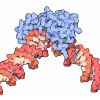
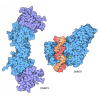
ジャーナル: EMBO Rep / 年: 2019 タイトル: CENP-C unwraps the human CENP-A nucleosome through the H2A C-terminal tail. 著者: Ahmad Ali-Ahmad / Silvija Bilokapić / Ingmar B Schäfer / Mario Halić / Nikolina Sekulić / 要旨: Centromeres are defined epigenetically by nucleosomes containing the histone H3 variant CENP-A, upon which the constitutive centromere-associated network of proteins (CCAN) is built. CENP-C is ...Centromeres are defined epigenetically by nucleosomes containing the histone H3 variant CENP-A, upon which the constitutive centromere-associated network of proteins (CCAN) is built. CENP-C is considered to be a central organizer of the CCAN. We provide new molecular insights into the structure of human CENP-A nucleosomes, in isolation and in complex with the CENP-C central region (CENP-C ), the main CENP-A binding module of human CENP-C. We establish that the short αN helix of CENP-A promotes DNA flexibility at the nucleosome ends, independently of the sequence it wraps. Furthermore, we show that, in vitro, two regions of human CENP-C (CENP-C and CENP-C ) both bind exclusively to the CENP-A nucleosome. We find CENP-C to bind with high affinity due to an extended hydrophobic area made up of CENP-A and CENP-A . Importantly, we identify two key conformational changes within the CENP-A nucleosome upon CENP-C binding. First, the loose DNA wrapping of CENP-A nucleosomes is further exacerbated, through destabilization of the H2A C-terminal tail. Second, CENP-C rigidifies the N-terminal tail of H4 in the conformation favoring H4 monomethylation, essential for a functional centromere.
 ムービー
ムービー コントローラー


 データを開く
 基本情報
基本情報 マップデータ
 試料
試料 キーワード
キーワード 機能・相同性情報
 Homo sapiens (ヒト) / synthetic construct (人工物)
 データ登録者
 ノルウェー,
  ドイツ, 2件
  引用
引用
 構造の表示
構造の表示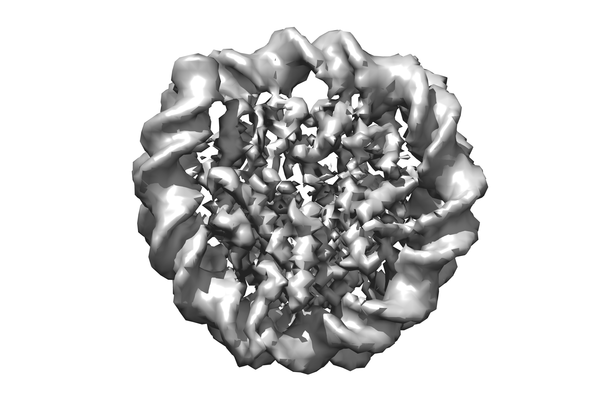
 ダウンロードとリンク
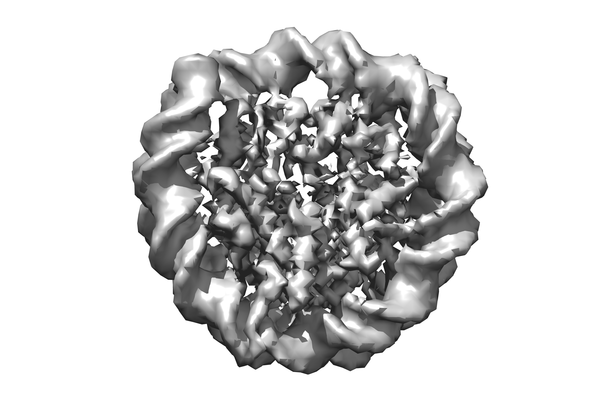 emd_10152.png
 http://ftp.pdbj.org/pub/emdb/structures/EMD-10152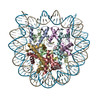
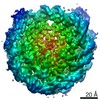


 Z (Sec.)
 Y (Row.)
 X (Col.)


 試料の構成要素
 Escherichia coli (大腸菌)
 解析
解析 電子顕微鏡法
 FIELD EMISSION GUN
