






 9ZIP
9ZIP
Crystal Structure of RASProtease(II), a Designed RAS-specific Subtilisin, in Complex with the Cognate Peptide QEEYSAM
Summary for 9ZIP
| Entry DOI | 10.2210/pdb9zip/pdb |
| Descriptor | SUBTILISIN BPN', Peptide QEEYSAM, 1,2-ETHANEDIOL, ... (7 entities in total) |
| Functional Keywords | engineered protease, hydrolase |
| Biological source | Bacillus amyloliquefaciens More |
| Total number of polymer chains | 4 |
| Total formula weight | 55923.33 |
| Authors | |
| Primary citation | Chu, B.,He, Y.,Chen, Y.,Toth, E.A.,Orban, J. Substrate specificity in a designed RAS-targeting protease is coupled to active site and distal motions. Biorxiv, 2026 Cited by PubMed Abstract: Designing proteases with tailored substrate specificity has emerged as a powerful strategy for manipulating protein function in cells. RAS, a key regulator of cell survival and proliferation, is a compelling target for such approaches. Mutations in RAS are involved in about one-third of all human cancers and drive the hyperactive signaling that promotes tumorigenesis, growth, and metastasis in cancers such as pancreatic and lung cancer. This creates a pressing need for strategies capable of modulating mutant RAS with high substrate specificity to avoid unintended cleavage events. As a model for targeted proteolysis, we present the high-resolution crystal structures of RASProtease(II), which provide a detailed view of the enzyme's active site and substrate-binding architecture. Kinetic experiments showed that cleavage of the cognate QEEYSAM substrate is approximately 30-fold faster than the non-cognate QEEISAM, demonstrating strong proteolytic selectivity. NMR dynamics studies combined with structural mapping revealed that substrate binding modulates not only the active site, but also distal regions of RASProtease(II), uncovering long-range allosteric networks. Contrary to the conventional view that non-cognate substrates are simply poor fits for the active site, we found that binding of the non-cognate peptide induces a greater amount of conformational dynamics in the protease than in the apo form or cognate complex, resulting in significant destabilization and providing a mechanistic explanation for the reduced catalytic efficiency. These results reveal how distal structural networks help define substrate specificity and provide principles for rationally designing proteases with enhanced specificity for therapeutic applications. PubMed: 41648245DOI: 10.64898/2026.01.15.699477 PDB entries with the same primary citation |
| Experimental method | X-RAY DIFFRACTION (1.24 Å) |
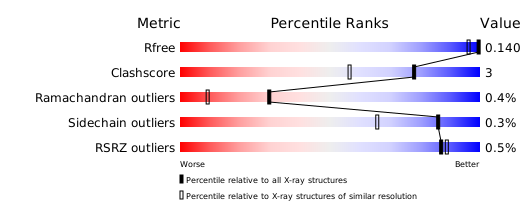
Structure validation
Download full validation report


