






 9YTF
9YTF
TCR mimic antibody vAB-30 in complex with MAGE-A3 in HLA-A1
Summary for 9YTF
| Entry DOI | 10.2210/pdb9ytf/pdb |
| EMDB information | 73460 |
| Descriptor | MHC class I antigen, Beta-2-microglobulin, Melanoma-associated antigen 3, ... (6 entities in total) |
| Functional Keywords | hla, tcr mimic antibody, de novo design, immune complex, immune system |
| Biological source | Homo sapiens (human) More |
| Total number of polymer chains | 6 |
| Total formula weight | 103397.11 |
| Authors | |
| Primary citation | Motmaen, A.,Jude, K.M.,Wang, N.,Minervina, A.,Feldman, D.,Lichtenstein, M.A.,Ebenezer, A.,Correnti, C.,Thomas, P.G.,Garcia, K.C.,Baker, D.,Bradley, P. Targeting peptide-MHC complexes with designed T cell receptors and antibodies. Biorxiv, 2025 Cited by PubMed Abstract: Class I major histocompatibility complexes (MHCs), expressed on the surface of all nucleated cells, present peptides derived from intracellular proteins for surveillance by T cells. The precise recognition of foreign or mutated peptide-MHC (pMHC) complexes by T cell receptors (TCRs) is central to immune defense against pathogens and tumors. Although patient-derived TCRs specific for cancer-associated antigens have been used to engineer tumor-targeting therapies, their reactivity toward self- or near-self antigens may be constrained by negative selection in the thymus. Here, we introduce a structure-based deep learning framework, ADAPT (Antigen-receptor Design Against Peptide-MHC Targets), for the design of TCRs and antibodies that bind to pMHC targets of interest. We evaluate the ADAPT pipeline by designing and characterizing TCRs and antibodies against a diverse panel of pMHCs. Cryogenic electron microscopy structures of two designed antibodies bound to their respective pMHC targets demonstrate atomic-level accuracy at the recognition interface, supporting the robustness of our structure-based approach. Computationally designed TCRs and antibodies targeting pMHC complexes could enable a broad range of therapeutic applications, from cancer immunotherapy to autoimmune disease treatment, and insights gained from TCR-pMHC design should advance predictive understanding of TCR specificity with implications for basic immunology and clinical diagnostics. PubMed: 41332722DOI: 10.1101/2025.11.19.689381 PDB entries with the same primary citation |
| Experimental method | ELECTRON MICROSCOPY (2.6 Å) |
Structure validation
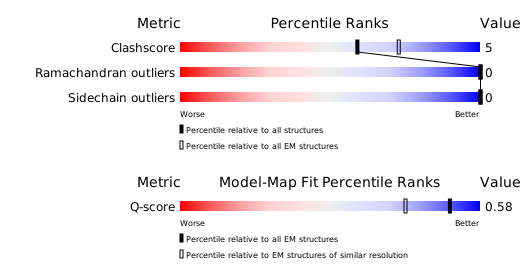
Download full validation report


