






 9YNM
9YNM
Crystal structure of de novo cysteine protease (Dokki_15 WT apo)
Summary for 9YNM
| Entry DOI | 10.2210/pdb9ynm/pdb |
| Descriptor | Dokki_15 WT apo (2 entities in total) |
| Functional Keywords | de novo design, cysteine proteases, enzyme design, deep learning method rfd2-mi, de novo protein |
| Biological source | synthetic construct |
| Total number of polymer chains | 1 |
| Total formula weight | 22032.69 |
| Authors | Bera, A.K.,Choi, H.,Kang, A.,Nguyen, H.,Baker, D. (deposition date: 2025-10-10, release date: 2026-07-15) |
| Primary citation | Choi, H.,Coventry, B.,Bauer, M.,Venkatesh, P.,Chen, A.,Kim, D.,Bera, A.K.,Kang, A.,Nguyen, H.,Joyce, E.,Shankaran, B.,Thompson, T.R.,Gershon, J.M.,Shida, A.F.,Lee, G.R.,Hilvert, D.,Pellock, S.J.,Baker, D. Computational design of cysteine proteases. Biorxiv, 2025 Cited by PubMed Abstract: Despite advances in de novo enzyme design, success has been largely limited to low energy barrier model reactions. Amide bonds such as those linking amino acids along the peptide backbone are stable for hundreds of years in neutral aqueous solution because of the high energy barrier to hydrolysis . Here we describe the use of a new deep learning method, RFD2-MI , to de novo design enzymes which utilize an activated cysteine nucleophile to hydrolyze the polypeptide backbone in a sequence-dependent manner, achieving rate enhancements over the background reaction ( / ) of up to 3 × 10 . The generated designs have folds very different from the proteases in nature (TM score < 0.50), and crystal structures are very close to the design models (Cα RMSDs < 1.2 Å), highlighting the accuracy of the design methodology. Our approach has broad utility for advancing the design of novel proteases for both biotechnical and medical applications. PubMed: 41332739DOI: 10.1101/2025.11.21.689808 PDB entries with the same primary citation |
| Experimental method | X-RAY DIFFRACTION (1.56 Å) |
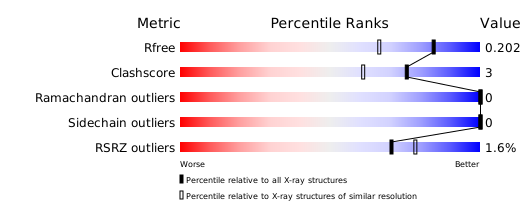
Structure validation
Download full validation report


