






 9YK1
9YK1
Room-temperature X-ray structure of D132N Bacillus halodurans RNase H1 in complex with RNA/DNA duplex
Summary for 9YK1
| Entry DOI | 10.2210/pdb9yk1/pdb |
| Related | 9YJL 9YJM |
| Descriptor | Ribonuclease H, RNA (5'-R(*UP*CP*GP*AP*CP*A)-3'), DNA (5'-D(*AP*TP*GP*TP*CP*G)-3'), ... (6 entities in total) |
| Functional Keywords | rna hydrolase, nucleic acid binding, rna/dna hybrid, hydrolase, hydrolase-rna-dna complex, hydrolase/rna/dna |
| Biological source | Halalkalibacterium halodurans More |
| Total number of polymer chains | 3 |
| Total formula weight | 19805.78 |
| Authors | Kovalevsky, A.,Gerlits, O. (deposition date: 2025-10-06, release date: 2026-03-18, Last modification date: 2026-04-01) |
| Primary citation | Gerlits, O.,Collins, A.,Kovalevsky, A. Structural insights into RNase H catalytic mechanism from room-temperature X-ray and neutron crystallography of apo- and RNA/DNA hybrid-bound enzyme. Curr Res Struct Biol, 11:100188-100188, 2026 Cited by PubMed Abstract: RNase H enzymes are sequence-nonspecific endonucleases that cleave RNA strands in RNA/DNA hybrid duplexes, an enzymatic process essential in DNA replication and repair in both prokaryotes and eukaryotes. Also, RNase H activity of the reverse transcriptase in human immunodeficiency viruses (HIV-1 and HIV-2) is indispensable for the viral replication cycle. RNase H enzymes play an central role in the development of gene therapies and are targets for novel antivirals. It is therefore of great importance to gain a detailed understanding of the RNase H catalytic mechanism to improve drug design. We utilized RNase H1 (RNase H1) to shed light on its function and catalytic mechanism. Room-temperature neutron crystallography of the wild-type and inactive D132N mutant enzymes revealed that E109, belonging to the catalytic DEDD motif, can change its protonation state, allowing us to propose its role in the protonation of the leaving O3' hydroxyl group of RNA. X-ray crystallography has demonstrated the ability of the RNA/DNA duplex to slide along the protein surface upon metal ion binding at site M, transforming a product mimic into a Michaelis-like complex, which confirms an essential role of the M metal ion in catalysis. PubMed: 41853683DOI: 10.1016/j.crstbi.2026.100188 PDB entries with the same primary citation |
| Experimental method | X-RAY DIFFRACTION (1.8 Å) |
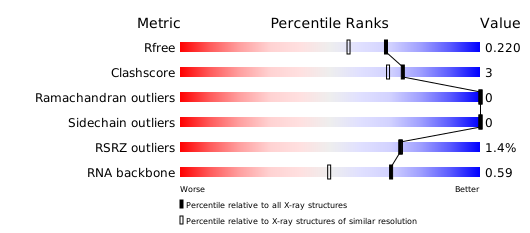
Structure validation
Download full validation report


