






 9YI4
9YI4
Octopus sensory receptor CRT1 bound to Progesterone
Summary for 9YI4
| Entry DOI | 10.2210/pdb9yi4/pdb |
| EMDB information | 72977 |
| Descriptor | Chemotactile receptor CRT1, 2-acetamido-2-deoxy-beta-D-glucopyranose, PROGESTERONE (3 entities in total) |
| Functional Keywords | complex, membrane protein |
| Biological source | Octopus bimaculoides (California two-spot octopus) |
| Total number of polymer chains | 5 |
| Total formula weight | 243773.82 |
| Authors | Jiang, H.,Hibbs, R.E. (deposition date: 2025-10-01, release date: 2026-04-01, Last modification date: 2026-05-06) |
| Primary citation | Villar, P.S.,Jiang, H.,Shugaeva, T.,Berdan, E.L.,Kulkarni, A.,Hiroi, M.,Masucci, G.,Reiter, S.,Lindahl, E.,Howard, R.J.,Hibbs, R.E.,Bellono, N.W. A sensory system for mating in octopus. Science, 392:96-101, 2026 Cited by PubMed Abstract: Sensory systems for mate recognition maintain species boundaries and influence diversification. Thus, uncovering how molecules and receptors evolve to mediate this critical function is essential to understanding biodiversity. Male octopuses use a specialized arm called the hectocotylus to identify females and navigate their internal organs to reach the oviduct and deliver sperm. Here, we discovered that the hectocotylus is a dual sensory and mating organ that uses contact-dependent chemosensation of progesterone, a conserved ovarian hormone. We identified chemotactile receptors for progesterone and resolved the structural basis for their evolution from ancestral neurotransmitter receptors and subsequent expansion and tuning across cephalopods. These findings reveal principles by which sensory innovations shape reproductive behavior and suggest mechanisms for how sensory evolution contributes to the diversification of life. PubMed: 42012846DOI: 10.1126/science.aec9652 PDB entries with the same primary citation |
| Experimental method | ELECTRON MICROSCOPY (2.8 Å) |
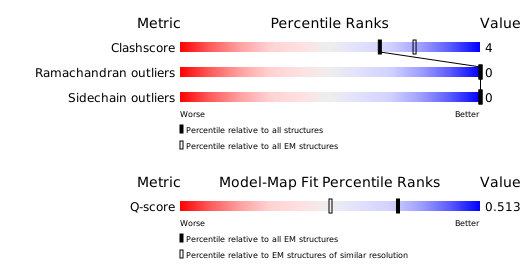
Structure validation
Download full validation report


