






 9Y7H
9Y7H
Gb1g2 crosslinked to PLCb3
Summary for 9Y7H
| Entry DOI | 10.2210/pdb9y7h/pdb |
| EMDB information | 72655 |
| Descriptor | 1-phosphatidylinositol 4,5-bisphosphate phosphodiesterase beta-3, Guanine nucleotide-binding protein G(I)/G(S)/G(T) subunit beta-1, Guanine nucleotide-binding protein G(I)/G(S)/G(O) subunit gamma-2, ... (5 entities in total) |
| Functional Keywords | heterotrimeric g protein, phospholipase, lipase, calcium signaling, signaling protein |
| Biological source | Homo sapiens (human) More |
| Total number of polymer chains | 3 |
| Total formula weight | 144261.21 |
| Authors | |
| Primary citation | Fisher, I.J.,Senarath, K.,Outlaw, K.,Muralidharan, K.,Garland-Kuntz, E.E.,Van Camp, M.,Komay, T.,Inoue, A.,Kostenis, E.,Lambert, N.A.,Lyon, A.M. G beta gamma engages PLC beta 3 at multiple sites to reorient and facilitate its activation. Biorxiv, 2026 Cited by PubMed Abstract: Phospholipase C β (PLCβ) enzymes are activated by heterotrimeric G protein subunits, increasing hydrolysis of phosphatidylinositol-4,5-bisphosphate (PIP2) at the plasma membrane. All four human PLCβ isoforms (PLCβ1-4) are activated by Gα, while PLCβ1-3 are activated to varying extents by Gβγ. The binding sites for Gα on PLCβ are well-established and much has been learned about its mechanism of activation, but comparatively little is known about Gβγ-dependent activation. In this work, we used cryo-electron microscopy (cryo-EM) single particle analysis (SPA), functional assays, and bioluminescence resonance energy transfer (BRET) to investigate how Gβγ interacts with PLCβ3 in concert with activated Gα to regulate phospholipase activity. Gβγ heterodimers bind multiple surfaces of PLCβ3 to promote activation but alone do not recruit the enzyme to the plasma membrane. Instead, Gβγ facilitates activation by Gα, most likely by reorienting the phospholipase catalytic site at the membrane to maximize PIP2 hydrolysis and downstream Ca release. Cell-based functional assays demonstrate that Gβγ is required for maximal PLCβ3 activation even when G heterotrimers are the sole source of Gβγ. Together, these findings demonstrate that Gβγ acts as a critical positive allosteric modulator that regularly acts in concert with Gα to activate PLCβ3 at the plasma membrane. PubMed: 41648476DOI: 10.64898/2026.01.14.699417 PDB entries with the same primary citation |
| Experimental method | ELECTRON MICROSCOPY (4.4 Å) |
Structure validation
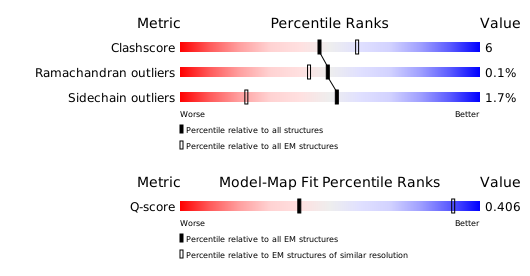
Download full validation report


