






 9XVC
9XVC
Cryo-EM Helical Structure of the dITP-KomBC(H146N) Complex with NAD Fragments
Summary for 9XVC
| Entry DOI | 10.2210/pdb9xvc/pdb |
| EMDB information | 67286 |
| Descriptor | KomB, HAM-like protein, Non-canonical purine NTP pyrophosphatase, KomC(H146N), a SIR2-domain NADase, 2'-deoxyinosine 5'-triphosphate, ... (4 entities in total) |
| Functional Keywords | kombc, nad hydrolysis protein, immune system |
| Biological source | Escherichia coli More |
| Total number of polymer chains | 16 |
| Total formula weight | 419202.88 |
| Authors | |
| Primary citation | Feng, H.,Shao, K.,Zeng, Z.,Tan, E.Y.J.,Hu, Z.,Zhao, R.,Rao, J.,Shi, J.,Chen, Z.,Redondo, R.P.,Wu, B.,Han, W.,Luo, M. Filament-mediated repurposing of toxic dITP for immunity in the Kongming system. Mol.Cell, 86:1148-1163.e5, 2026 Cited by PubMed Abstract: Abortive infection systems protect bacteria by triggering self-destruction in response to phage attack. Most known systems rely on stable cyclic nucleotides that accumulate to stoichiometric levels to activate effectors; the Kongming (Kom) system employs the toxic metabolite deoxyinosine triphosphate (dITP) as its signaling molecule. Here, we show that the Escherichia coli KomB-KomC (KomBC) complex forms a preassembled filament that remains inactive until dITP binding induces cooperative allosteric activation. KomB, a homolog of the nucleotide-hydrolyzing enzyme HAM1, has lost catalytic activity but evolved a high-affinity, hydrolysis-resistant binding pocket for dITP. Interestingly, substoichiometric dITP binding is sufficient to activate adjacent KomC NADase domains, which propagate activation cooperatively along the filament. This filament-based architecture enables ultrasensitive, long-range allosteric signaling in response to a low-abundance and short-lived metabolite. Our findings reveal an ultrasensitive immune strategy that transforms a toxic byproduct into a robust antiviral trigger, expanding the known repertoire of bacterial defense strategies. PubMed: 41638214DOI: 10.1016/j.molcel.2026.01.027 PDB entries with the same primary citation |
| Experimental method | ELECTRON MICROSCOPY (3.2 Å) |
Structure validation
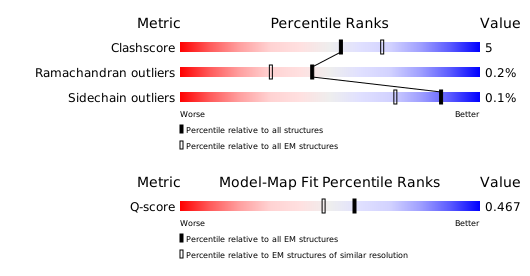
Download full validation report


