






 9X3Y
9X3Y
NPFF bound Mas1 Receptor
Summary for 9X3Y
| Entry DOI | 10.2210/pdb9x3y/pdb |
| EMDB information | 66514 |
| Descriptor | Proto-oncogene Mas, NPFF (2 entities in total) |
| Functional Keywords | gpcr, agonist, orphan receptor, peptide binding protein |
| Biological source | Homo sapiens (human) More |
| Total number of polymer chains | 2 |
| Total formula weight | 38585.30 |
| Authors | Zhang, Y.M.,Liu, H.,Xu, H.E. (deposition date: 2025-10-09, release date: 2026-04-15, Last modification date: 2026-06-03) |
| Primary citation | Zhang, Y.,Wang, Q.,Liu, H.,Shan, H.,Gu, Y.,Yang, J.,Gao, Y.,Wu, K.,Yang, D.,Xu, H.E. Structural insight into ligand binding and activation of the orphan GPCR Mas1. Embo J., 45:3500-3513, 2026 Cited by PubMed Abstract: The Mas1 receptor, an orphan class A G-protein-coupled receptor (GPCR), plays pivotal roles in cardiovascular and anti-inflammatory regulation. Despite its therapeutic relevance, the structural mechanisms underlying Mas1 ligand binding and activation remain poorly understood. Here, we report cryo-EM structures of Mas1 bound to two chemically distinct agonists-neuropeptide FF (NPFF) and synthetic small-molecule AR234958-captured in complex with inhibitory G proteins. These structures reveal a conserved orthosteric binding pocket accommodating both ligands through shared hydrophobic interactions. Unlike many other class A GPCRs that rely on direct W toggle switch engagement, Mas1 adopts a non-canonical activation strategy driven by a ligand-induced hydrophobic compression plane involving residues Y248, L87, I84, and L266 at the bottom of the ligand binding pocket. This mechanism transmits mechanical tension to promote TM6 displacement and G protein coupling. Functional mutagenesis validates this model, identifying two transmembrane helix 6 (TM6) residues, M244 and F237, as critical molecular switches. Comparative analyses of Mas1-related receptors, MRGPRX1-X4, reveal conserved features and mechanistic divergence within this subfamily. These findings provide a structural framework for understanding Mas1 pharmacology and rational design of selective therapeutics. PubMed: 41912627DOI: 10.1038/s44318-026-00764-6 PDB entries with the same primary citation |
| Experimental method | ELECTRON MICROSCOPY (2.77 Å) |
Structure validation
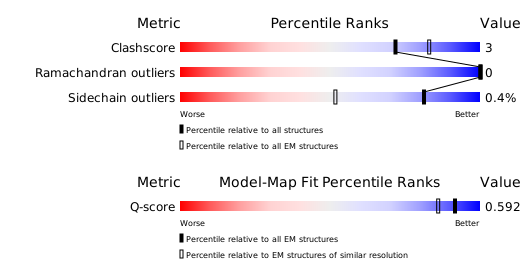
Download full validation report


