






 9WPY
9WPY
cryo-EM structure of human organic solute transporter in complex with DHEAS
Summary for 9WPY
| Entry DOI | 10.2210/pdb9wpy/pdb |
| EMDB information | 66153 |
| Descriptor | Organic solute transporter subunit alpha, Organic solute transporter subunit beta, CHOLESTEROL, ... (6 entities in total) |
| Functional Keywords | dheas, transporter, transport protein |
| Biological source | Homo sapiens (human) More |
| Total number of polymer chains | 4 |
| Total formula weight | 117014.31 |
| Authors | |
| Primary citation | Sun, X.,Tian, T.,Low, M.,Li, S.,Yao, D.,Yuan, Y.,Cao, M.,Lei, M.,Wang, Y.,Chen, H.,Lan, P.,Xia, Q.,Xue, J. Structural insights into OST alpha / beta-mediated transport of bile acids and steroid conjugates. Nat.Struct.Mol.Biol., 33:1288-1298, 2026 Cited by PubMed Abstract: Mammalian organic solute transporter α/β (OSTα/β) is crucial for the enterohepatic circulation of bile acids and the homeostasis of steroid conjugates, mediating their movement across membranes as an obligate heterodimer. Here we present high-resolution cryo-EM structures of human OSTα/β in apo, substrate-bound and inhibitor-bound states, revealing a tetrameric organization as a homodimer of heterodimers that is required for membrane activity. Substrates bind within a surface-exposed tunnel formed by transmembrane helices 5 and 6, which is unexpectedly sealed by multiple palmitoyl chains covalently attached to a conserved intracellular loop IL2. Two chemically distinct inhibitors, fidaxomicin and ethinylestradiol, disrupt transport by both competing for the substrate-binding pocket and sterically occluding the tunnel. Together with biochemical and evolutionary analyses, our work defines a distinctive class of solute carriers that uses palmitoylation to facilitate substrate transport, a mechanism conserved across eukaryotes. PubMed: 42304113DOI: 10.1038/s41594-026-01825-4 PDB entries with the same primary citation |
| Experimental method | ELECTRON MICROSCOPY (2.99 Å) |
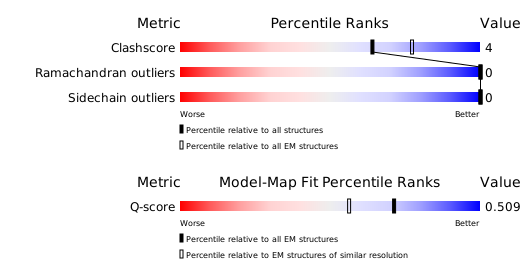
Structure validation
Download full validation report


