






 9WA7
9WA7
Crystal Structure of Human NFIX in Complex with TGGCA(N3)TGCCA Palindromic DNA
Summary for 9WA7
| Entry DOI | 10.2210/pdb9wa7/pdb |
| Descriptor | Nuclear factor 1 X-type, DNA (5'-D(*AP*GP*TP*TP*GP*GP*CP*AP*AP*GP*AP*TP*GP*CP*CP*AP*TP*C)-3'), DNA (5'-D(*GP*AP*TP*GP*GP*CP*AP*TP*CP*TP*TP*GP*CP*CP*AP*AP*CP*T)-3'), ... (5 entities in total) |
| Functional Keywords | nfix, transcription factor, skeletal muscle development, dna binding protein |
| Biological source | Homo sapiens (human) More |
| Total number of polymer chains | 3 |
| Total formula weight | 30284.19 |
| Authors | |
| Primary citation | Zhu, C.,Liu, S.,Chen, X.,Qin, C.,Wang, Y.,Xue, C.,Li, L.,Du, W.,Chen, X.,Li, X.,Shen, J.,Song, H. Mechanistic Insights Into NFIX-Mediated DNA Recognition and Transcriptional Regulation in Skeletal Muscle. Smart Med, 5:e70027-e70027, 2026 Cited by PubMed Abstract: Skeletal muscle is essential for voluntary movement and exhibits a remarkable capacity for regeneration following injury. NFIX, a member of the Nuclear Factor I (NFI) family of transcription factors, plays a critical role in both skeletal muscle development and regeneration. Despite its emerging importance, the molecular basis of NFIX-mediated DNA recognition and transcriptional regulation in skeletal muscle remains poorly defined. Here, we demonstrate that NFIX promotes key cellular processes in skeletal muscle cells, as siRNA-mediated knockdown of NFIX significantly reduces cell proliferation, increases apoptosis, and impairs differentiation. Transcriptomic analysis revealed that NFIX regulates a network of genes involved in muscle metabolism, stress responses, and immune inflammatory responses. Biophysical characterization showed that NFIX exists as a monomer in solution and binds palindromic DNA with a 1:1 stoichiometry. A high-resolution crystal structure of the NFIX bound to palindromic DNA reveals a monomeric binding mode driven by base-specific recognition of the TGGCA motif. Mutations that disrupt key DNA-contacting residues abolished both DNA binding and transcriptional activation in luciferase reporter assays. Together, these findings define the molecular mechanism of NFIX-dependent gene regulation in skeletal muscle and establish a structural framework for its function, providing new insights into the potential therapeutic targeting of NFIX in muscle diseases. PubMed: 41623611DOI: 10.1002/smmd.70027 PDB entries with the same primary citation |
| Experimental method | X-RAY DIFFRACTION (2.31 Å) |
Structure validation
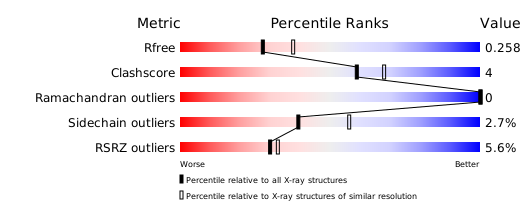
Download full validation report


