






 9VMO
9VMO
Cryo-EM structure of the ITA-OXGR1-Gq complex
Summary for 9VMO
| Entry DOI | 10.2210/pdb9vmo/pdb |
| EMDB information | 65193 |
| Descriptor | Guanine nucleotide-binding protein G(q) subunit alpha isoforms short, Guanine nucleotide-binding protein G(I)/G(S)/G(T) subunit beta-1, Guanine nucleotide-binding protein G(I)/G(S)/G(O) subunit gamma-2, ... (6 entities in total) |
| Functional Keywords | oxgr1, gq, ita, membrane protein, membrane protein-immune system complex, membrane protein/immune system |
| Biological source | Homo sapiens (human) More |
| Total number of polymer chains | 5 |
| Total formula weight | 144269.51 |
| Authors | Tang, X.J.,Sun, J.P.,Guo, L.L.,Li, J.,Deng, Z.L.,Xiao, W.Q.,Zhu, Y.,Zhu, K.K. (deposition date: 2025-06-28, release date: 2026-03-18, Last modification date: 2026-04-15) |
| Primary citation | Xiao, W.,Zhu, Y.,Tang, X.,Zhu, K.,Zhang, W.,Chen, M.,Cai, K.,Xu, S.,Wu, Z.,Wang, M.,Liu, J.,Long, L.,Tan, Z.,Wu, A.,Zhou, S.,Zhao, Z.,Tang, Y.,Huang, Y.,Wang, B.,Liu, F.,Wang, Q.,Yang, F.,Jian, D.,Shi, W.,Xie, H.,Chen, X.,Guo, L.,Deng, Z.,Sun, J.,Li, J. Metabolite-gated vascular contractility switch: OXGR1 activation mechanism enables agonist therapy for rosacea erythema. Cell, 189:1990-2006.e30, 2026 Cited by PubMed Abstract: Rosacea, an inflammatory skin disorder, poses a dilemma owing to limited effectiveness of treatments for pathological vasodilation-mediated erythema. Here, we identify oxoglutaric acid (α-KG) as a rosacea-associated metabolite elevated in patients and correlated with erythema severity. Exogenous α-KG administration ameliorates rosacea-like manifestations in murine models. Mechanistically, α-KG activates OXGR1, a vascular smooth muscle cell (VSMC)-enriched G protein-coupled receptor (GPCR) to induce Gq signaling and enhance MYL9 phosphorylation, promoting VSMC contraction and limiting vasodilation. Cryo-electron microscopy (cryo-EM) structures of OXGR1-Gq complexes bound to α-KG or itaconate reveal a specific bipartite-acid pocket recognizing its endogenous agonist and an activation mechanism distinct from classical GPCRs. Building on these structures, we developed A-1, a synthetic selective OXGR1 agonist that mitigates erythema and inflammation with efficacy comparable to first-line therapy while offering enhanced safety in rosacea-like models. These findings link a metabolite to vascular dysfunction and nominate OXGR1 agonism for precision treatment of erythema and vascular disorders. PubMed: 41791372DOI: 10.1016/j.cell.2026.01.036 PDB entries with the same primary citation |
| Experimental method | ELECTRON MICROSCOPY (2.4 Å) |
Structure validation
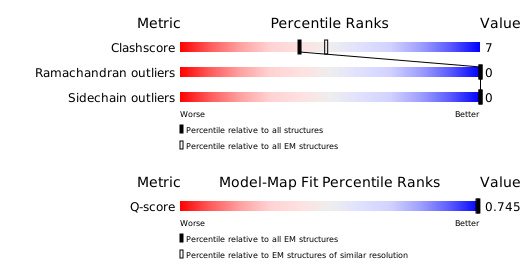
Download full validation report


