






 9VFG
9VFG
Solution structure of silver bound XPC binding domain of hHR23B (holo form)
Summary for 9VFG
| Entry DOI | 10.2210/pdb9vfg/pdb |
| Related | 9VFE 9VFF |
| Descriptor | UV excision repair protein RAD23 homolog B, SILVER ION (2 entities in total) |
| Functional Keywords | silver bound form, metal binding protein |
| Biological source | Homo sapiens (human) |
| Total number of polymer chains | 1 |
| Total formula weight | 8178.87 |
| Authors | |
| Primary citation | Xiao, T.,He, D.,Liu, D.,Jia, S.,Chen, Q.,Silverman, D.,Maitra, N.,Huang, A.Y.,Pezacki, A.,Nguyen, T.T.,Rao, G.,Tillage, R.,Deng, K.,Weinshenker, D.,Britt, R.D.,Kelly, M.J.S.,Dan, Y.,Chang, C.J. RAD23B acquires a copper metalloadaptor function in amphibian-to-reptile evolution to increase metabolism and regulate genomic integrity. Mol.Cell, 85:3443-3459.e11, 2025 Cited by PubMed Abstract: Increasing brain complexity is a major step in the evolution of species. Here, we show that, in the transition from amphibians to reptiles, the DNA repair protein RAD23B acquires a metalloadaptor function that allows it to serve as a central hub for both metabolism and protection of genomic integrity. More specifically, RAD23B gains an allosteric H274/H323 copper-binding site to enable the transfer of copper from the universal copper transporter 1 (CTR1) uptake protein to all known copper metallochaperone pathways, while simultaneously making its canonical functions in DNA repair copper dependent. This layer of nutrient regulation allows organisms to withstand elevated levels of potentially toxic copper while augmenting metabolism in cells with high energetic needs across both physiology and disease, including neurons in the locus coeruleus, a key brain structure that regulates sleep, and cancer cells. PubMed: 40972527DOI: 10.1016/j.molcel.2025.08.024 PDB entries with the same primary citation |
| Experimental method | SOLUTION NMR |
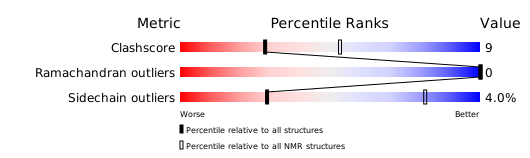
Structure validation
Download full validation report


