






9VDO
Cryo-EM structure of the substrate bound DRT4
Summary for 9VDO
| Entry DOI | 10.2210/pdb9vdo/pdb |
| EMDB information | 64990 |
| Descriptor | Reverse transcriptase domain-containing protein, DNA (5'-D(P*CP*CP*CP*AP*A)-3'), 2'-DEOXYCYTIDINE-5'-TRIPHOSPHATE, ... (4 entities in total) |
| Functional Keywords | ug15, drt4, reverse transcriptases, ug/abi system, dna binding protein/dna, dna binding protein-dna complex |
| Biological source | Escherichia coli More |
| Total number of polymer chains | 12 |
| Total formula weight | 395622.49 |
| Authors | |
| Primary citation | Wang, Y.,Wu, H.,Li, J.,An, Q.,Tian, Z.,Deng, Z. Anti-phage defense mechanism involving phage-encoded DNA binding protein and bacterial reverse transcriptase DRT4. Nat Commun, 17:289-289, 2025 Cited by PubMed Abstract: Prokaryotic defense-associated reverse transcriptase (DRT) systems confer host resistance to viral infection through DNA synthesis; however, the molecular mechanisms underlying their function remain poorly understood. Here, we demonstrate that DRT4, a single-gene anti-phage defense system, synthesizes single-stranded DNA (ssDNA) products of random sequences in a template-independent manner. High-resolution cryo-EM structures of DRT4 in multiple functional states elucidate its oligomeric architecture, catalytic metal ion coordination, and substrate/DNA product binding, offering mechanistic insights into its promiscuous polymerization activity. Structural and biochemical analyses further identify a conserved tyrosine residue that acts as the priming site for the initiation of DNA synthesis. Upon phage infection, a phage-encoded DNA-binding protein, ORF55, protects the 3' end of the DRT4-synthesized ssDNA from host exonuclease degradation, likely resulting in toxic ssDNA accumulation that leads to cell death. Remarkably, ORF55 also activates DRT6, a structural homolog of DRT4, suggesting a conserved activation mechanism among related DRT systems. These findings provide structural and mechanistic insights into DRT4-mediated antiviral defense, establishing a distinct paradigm for antiviral reverse transcriptase in bacterial immunity. PubMed: 41330908DOI: 10.1038/s41467-025-66997-x PDB entries with the same primary citation |
| Experimental method | ELECTRON MICROSCOPY (2.93 Å) |
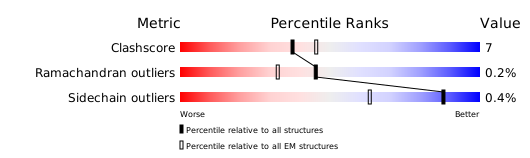
Structure validation
Download full validation report


