






 9UWD
9UWD
Cryo-EM structure of inactive-DP1
Summary for 9UWD
| Entry DOI | 10.2210/pdb9uwd/pdb |
| EMDB information | 64550 |
| Descriptor | Prostaglandin D2 receptor,Soluble cytochrome b562 (1 entity in total) |
| Functional Keywords | gpcr, dp1, inactive, membrane protein |
| Biological source | Homo sapiens (human) More |
| Total number of polymer chains | 1 |
| Total formula weight | 47773.95 |
| Authors | |
| Primary citation | Xu, J.,Wu, Y.,Xu, Y.,Li, Y.,He, X.,Zhang, H.,Wang, J.J.,Hou, J.,Li, J.,Hu, W.,Wu, K.,Yuan, Q.,Wu, C.,Xu, H.E. Molecular basis for ligand recognition and receptor activation of the prostaglandin D2 receptor DP1. Proc.Natl.Acad.Sci.USA, 122:e2501902122-e2501902122, 2025 Cited by PubMed Abstract: The prostaglandin D2 receptor 1 (DP1), a rhodopsin-like Class A GPCR, orchestrates critical physiological and pathological processes, ranging from sleep regulation to inflammatory responses and cardiovascular function. Despite its therapeutic significance, structural insights into DP1 activation mechanisms have remained elusive. Here, using cryoelectron microscopy (cryo-EM), we determined high-resolution structures of human DP1 in both inactive and active states, with the latter captured in complex with its endogenous agonist PGD2 or the synthetic agonist BW245C, bound to the stimulatory G protein, Gs. Our structures, coupled with functional and mutagenesis studies, unveiled unique structural features of DP1, including an alternative activation mechanism, ligand-selectivity determinants, and G protein coupling characteristics. These molecular insights provide a rational framework for designing selective DP1-targeted therapeutics, both agonists and antagonists, with enhanced specificity and reduced off-target effects, opening broad avenues for treating DP1-associated disorders. PubMed: 40440061DOI: 10.1073/pnas.2501902122 PDB entries with the same primary citation |
| Experimental method | ELECTRON MICROSCOPY (3.41 Å) |
Structure validation
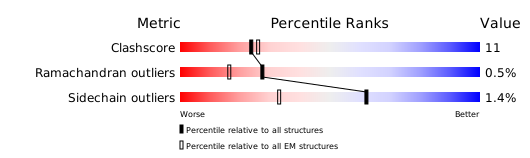
Download full validation report


