






 9UES
9UES
Crystal structure of an inactive TKSP mutant in complex with the TKS propeptide
Summary for 9UES
| Entry DOI | 10.2210/pdb9ues/pdb |
| Descriptor | Tk-subtilisin, Subtilisin-like serine protease, CALCIUM ION (3 entities in total) |
| Functional Keywords | subtilase, propeptide, maturation, hyperthermophile, hydrolase |
| Biological source | Thermococcus kodakarensis KOD1 More |
| Total number of polymer chains | 2 |
| Total formula weight | 52076.83 |
| Authors | Uehara, R.,Nishizaki, S.,Amesaka, H.,Takano, K.,Matsumura, H.,Tanaka, S.-i. (deposition date: 2025-04-09, release date: 2026-02-18) |
| Primary citation | Uehara, R.,Nishizaki, S.,Amesaka, H.,Takano, K.,Matsumura, H.,Tanaka, S.I. Propeptide-mediated enhancement of hyperthermophilic subtilisin-like protease expression in Escherichia coli. Amb Express, 15:136-136, 2025 Cited by PubMed Abstract: Subtilisin-like serine proteases (subtilases) are widely used in industrial applications, particularly in the detergents, due to their robust catalytic properties. The hyperthermophilic archaeon KOD1 secretes TKSP, a highly stable subtilase capable of degrading pathogenic prion proteins under harsh conditions. TKSP is secreted as a precursor comprising an N-terminal propeptide (TKSPpro) fused to the catalytic domain. Although the TKSP precursor can be solubly expressed in , TKSPpro, which transiently inhibits the catalytic domain, is rapidly cleaved. This releases active TKSP prematurely, leading to degradation of host proteins and severely limiting production yields. To address this issue, we developed a co-expression system in which the TKSP precursor is expressed alongside TKSpro, the propeptide of TKS, a homologous subtilase from KOD1. TKSpro is a potent inhibitor of its cognate catalytic domain due to its high structural rigidity and strong binding affinity. Co-expression with TKSpro enhanced TKSP expression levels by up to tenfold compared to expression without the propeptide. Crystallographic analysis of TKSpro in complex with TKSP lacking TKSPpro revealed that TKSpro binds complementarily to the catalytic domain, with the extended C-terminal region occupying the substrate-binding pocket. Mutational analysis further demonstrated that the structural rigidity and inhibitory potency of TKSpro correlates with TKSP expression yield in the co-expression system. This study demonstrates the importance of forming a stable inhibitory complex with an exogenous propeptide to suppress premature activation and enhance heterologous expression of cytotoxic subtilases in , providing a useful strategy for the production of proteolytically active enzymes. PubMed: 41003927DOI: 10.1186/s13568-025-01952-z PDB entries with the same primary citation |
| Experimental method | X-RAY DIFFRACTION (3.2 Å) |
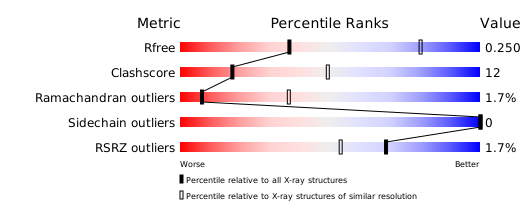
Structure validation
Download full validation report


