






 9UE2
9UE2
Crystal Structure of the Fluoroacetate Dehalogenase RPA1163 - Lys181Ser/Trp185Gly/His280Ala with (S)-2-fluoro-3-(4-(trifluoromethyl)phenyl)propanoic acid
This is a non-PDB format compatible entry.
Summary for 9UE2
| Entry DOI | 10.2210/pdb9ue2/pdb |
| Descriptor | Fluoroacetate dehalogenase, 3-[4-(trifluoromethyl)phenyl]propanoic acid (3 entities in total) |
| Functional Keywords | fluoroacetate dehalogenase, transferase |
| Biological source | Rhodopseudomonas palustris CGA009 |
| Total number of polymer chains | 2 |
| Total formula weight | 67428.35 |
| Authors | Huang, H.S.,Zhang, Z.M. (deposition date: 2025-04-07, release date: 2025-12-31, Last modification date: 2026-07-15) |
| Primary citation | Wang, C.Z.,Huang, H.,Hu, Z.,Gao, L.,Lin, Z.Q.,Shi, M.,Song, Z.,Li, M.,Wang, Y.,Chen, K.W.,Liu, Y.,Ma, Y.,Chen, B.,Yan, Q.,Zhang, Z.M.,Wang, J.B. Creating highly active fluoroacetate dehalogenases via gate-based synergetic chain design. Nat Commun, 17:-, 2026 Cited by PubMed Abstract: Gate residues, acting in concert with distal dynamic networks, are emerging as critical yet underexploited regulators of enzymatic catalysis. Here we show that conformational dynamics analysis of fluoroacetate dehalogenase RPA1163 reveals a gate-based allosteric pair (K181-W185) that governs substrate access and reactivity. Network engineering of this pair yields a double mutant with high turnover number for α-fluorophenylpropionic acid (turnover number > 2 × 10⁵), establishing gate-centric allostery as a generalizable design principle. Structural and molecular dynamics analyses show that the activity enhancement arises from stabilization of catalytically competent open states through long-range coupling. Extension of this strategy to three additional dehalogenases confirms the universality of gate-based dynamic rewiring. Leveraging this framework, we establish a robust biocatalytic platform for stereoselective synthesis of α-fluoro and α-hydroxy carboxylic acids, achieving high productivity (turnover number > 3.7 × 10⁶) and enabling decagram-scale preparation of pharmaceutically relevant intermediates with high yield and enantioselectivity. Together, these findings establish gate-residue allostery as a powerful concept in protein engineering, bridging conformational dynamics with translational biocatalysis. PubMed: 42062289DOI: 10.1038/s41467-026-72741-w PDB entries with the same primary citation |
| Experimental method | X-RAY DIFFRACTION (1.37860295477 Å) |
Structure validation
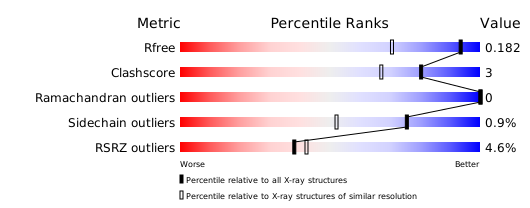
Download full validation report


