






 9TWA
9TWA
Legionella monocytogenes SodA mutant GL to VI
Summary for 9TWA
| Entry DOI | 10.2210/pdb9twa/pdb |
| Descriptor | Superoxide dismutase, FE (III) ION (3 entities in total) |
| Functional Keywords | superoxide dismutase, sod, redox, metalloenzyme, protein evolution, oxidoreductase |
| Biological source | Listeria monocytogenes |
| Total number of polymer chains | 2 |
| Total formula weight | 45479.97 |
| Authors | Mackenzie, E.S.,Basle, A.,Wldron, K.J. (deposition date: 2026-01-14, release date: 2026-03-11, Last modification date: 2026-04-01) |
| Primary citation | Mackenzie, E.S.,Sendra, K.M.,Basle, A.,Mazgaj, R.,Kehl-Fie, T.E.,Waldron, K.J. An enzyme's metal preference evolves through redox modulation driven by the cofactor's secondary coordination sphere. Mol.Biol.Evol., 43:-, 2026 Cited by PubMed Abstract: Changes in protein properties and functions are central to the evolution of life. Metalloproteins can evolve by changing their preference from one metal cofactor to another. Recently, we demonstrated that the widely distributed iron or manganese dependent superoxide dismutase (SodFM) family have undergone numerous metal-preference changes, including during evolutionary adaptation of pathogenic bacteria to altered metal availability within the host. Yet the underlying properties of metal-binding sites that control metalloenzyme metal-preference are unclear, and thus we lack an understanding of how enzymatic metal-preference can be re-shaped by evolution. Here, we used spectral features of bound iron or manganese, whose intensities reflect their oxidation state, to assess how their redox properties are tuned during SodFM evolution. We systematically analysed the metal oxidation state across diverse SodFMs from multiple phylogenetic groups with different catalytic metal-preferences, including those known to have undergone evolutionary metal-preference switching. We observed a striking relationship between resting oxidation state and catalytic metal-preferences. Mutagenesis of second-sphere residues previously identified as determining metal preference revealed that they modulate metal-dependent activity and cofactor oxidation state in tandem, demonstrating these properties are linked. Together, these data argue that the differing SodFM metal preferences observed across the tree of life evolved through tuning of their redox properties by the secondary coordination sphere. This study gives insight into the process by which a metalloenzyme originally optimised for one metal cofactor can evolve a new metal preference, under suitable selection pressure, through re-optimisation of its active site for catalytic reactivity of the new metal cofactor. PubMed: 41684149DOI: 10.1093/molbev/msag040 PDB entries with the same primary citation |
| Experimental method | X-RAY DIFFRACTION (1.4 Å) |
Structure validation
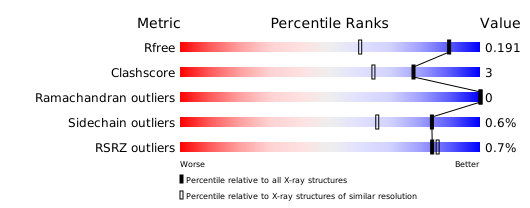
Download full validation report


