






 9TP8
9TP8
Crystal structure of the C-terminal Ser/Thr phosphatase D510N H707K mutant of the Kelch phosphatase BSU1 from Arabidopsis thaliana
Summary for 9TP8
| Entry DOI | 10.2210/pdb9tp8/pdb |
| Related | 9TP5 9TP7 |
| Descriptor | Serine/threonine-protein phosphatase BSU1, GLYCEROL, ACETATE ION, ... (4 entities in total) |
| Functional Keywords | protein phosphatase, ser/thr phosphatase, cell signaling, cell cycle |
| Biological source | Arabidopsis thaliana (thale cress) |
| Total number of polymer chains | 1 |
| Total formula weight | 44164.33 |
| Authors | |
| Primary citation | Rico-Resendiz, F.,Pri-Tal, O.,Raia, P.,Moretti, A.,Chen, H.,Yu, J.,Broger, L.,Fuchs, C.,Hothorn, L.A.,Loubery, S.,Hothorn, M. Plant Kelch phosphatases are Ser/Thr phosphatases involved in cell cycle regulation. Proc.Natl.Acad.Sci.USA, 123:e2600591123-e2600591123, 2026 Cited by PubMed Abstract: Brassinosteroids (BRs) are plant steroid hormones sensed by the membrane receptor kinase BRI1. Activation of BRI1 leads to the dephosphorylation of BZR1/BES1 transcription factors. Overexpression of the Kelch phosphatase BRI1 SUPPRESSOR 1 (BSU1) rescued the growth defects of mutants. Subsequent studies identified BSU1 as a protein tyrosine phosphatase, which promotes BR signaling by dephosphorylating a phosphotyrosine in the glycogen synthase kinase 3 BIN2. Crystal structures of the BSU1 phosphatase domain now reveal a high degree of structural similarity to protein phosphatase 1 (PP1), a eukaryotic serine/threonine phosphatase. Consistently, BSU1 efficiently dephosphorylated phosphothreonine- and phosphoserine-containing substrate peptides, but showed no detectable activity toward BIN2 and other phosphotyrosine substrates. A catalytically inactive BSU1 phosphatase domain suppresses the growth phenotypes of the Arabidopsis mutant and binds the BSU1 homologs BSL1-3. and loss-of-function mutants display wild-type-like BR responses, but exhibit stomatal patterning and fertility defects. Importantly, the PP1-like C-terminal tail of BSU1 is phosphorylated at Thr785 by a cyclin-dependent kinase complex. The phosphorylated tail binds to the BSU1 substrate-binding grooves, blocking access to the active site. Mutation of Thr785 to alanine activates BSU1, suggesting that Kelch phosphatases and PP1 share a common regulatory mechanism. Deletion of the Kelch phosphatase MpBSLM results in an undifferentiated cell mass phenotype, associated with the overactivation of a cell cycle reporter. Taken together, our experiments suggest that plant Kelch phosphatases act as PP1-like cell cycle regulators, rather than as tyrosine phosphatases in BR signaling. PubMed: 42166246DOI: 10.1073/pnas.2600591123 PDB entries with the same primary citation |
| Experimental method | X-RAY DIFFRACTION (1.6 Å) |
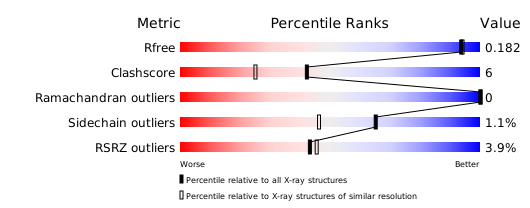
Structure validation
Download full validation report


