






 9TK8
9TK8
Cryogenic temperature structure of urocanate reductase in complex with urocanate in citrate condition
Summary for 9TK8
| Entry DOI | 10.2210/pdb9tk8/pdb |
| Descriptor | Urocanate reductase, FLAVIN-ADENINE DINUCLEOTIDE, (2E)-3-(1H-IMIDAZOL-4-YL)ACRYLIC ACID, ... (6 entities in total) |
| Functional Keywords | urocanate reductase, oxidoreductase |
| Biological source | Shewanella oneidensis MR-1 |
| Total number of polymer chains | 1 |
| Total formula weight | 51026.16 |
| Authors | Aggarwal, S.,Gurav, N.,Oksanen, E.,Lindkvist-Petersson, K.,Venskutonyte, R. (deposition date: 2025-12-08, release date: 2026-05-20, Last modification date: 2026-06-10) |
| Primary citation | Aggarwal, S.,Gurav, N.,Oksanen, E.,Lindkvist-Petersson, K.,Venskutonyte, R. Structural insights into urocanate reductase using room-temperature X-ray crystallography. Acta Crystallogr D Struct Biol, 82:603-614, 2026 Cited by PubMed Abstract: Urocanate reductase (UrdA) is a bacterial enzyme that converts urocanic acid to imidazole propionate. Its catalytic residue Arg411 undergoes a large conformational change in the substrate-bound versus product-bound states. In contrast to previously studied cryo-conditions, the room-temperature X-ray data of UrdA presented here show that the occupancy distribution of Arg411 is affected by crystal cryocooling. We further provide evidence that a phosphate ion stabilizes the substrate complex and can bias the conformation of Arg411. Both room-temperature and cryogenic X-ray datasets were essential to elucidate the dynamic nature of the UrdA active site, highlighting the importance of collecting data at both temperatures, as each may reveal distinct conformational states. PubMed: 42083916DOI: 10.1107/S2059798326003360 PDB entries with the same primary citation |
| Experimental method | X-RAY DIFFRACTION (1.9 Å) |
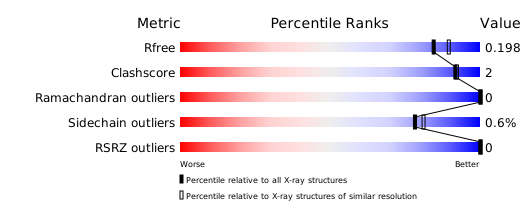
Structure validation
Download full validation report


