






 9TAD
9TAD
mCoral: a mCherry variant with cysteine replacing methionine in the chromophore
Summary for 9TAD
| Entry DOI | 10.2210/pdb9tad/pdb |
| Descriptor | mCherry Fluorescent protein, SULFATE ION (3 entities in total) |
| Functional Keywords | red-fluorescent, ph-dependent, biosensor, fluorescent protein |
| Biological source | Discosoma sp. |
| Total number of polymer chains | 1 |
| Total formula weight | 25036.22 |
| Authors | Zitti, A.,Rizkallah, P.J.,Jones, D.D. (deposition date: 2025-11-18, release date: 2025-12-31, Last modification date: 2026-01-21) |
| Primary citation | Zitti, A.,Aksakal, O.,Vitsupakorn, D.,Rizkallah, P.J.,Mikolajek, H.,Platts, J.A.,Menzies, G.E.,Jones, D.D. Structure, Function and Dynamics of mCoral, a pH-Responsive Engineered Variant of the mCherry Fluorescent Protein with Improved Hydrogen Peroxide Tolerance. Int J Mol Sci, 27:-, 2025 Cited by PubMed Abstract: The red fluorescent protein mCherry is one of the most widely used fluorescent proteins in biology. Here, we have changed the chromophore chemistry by converting the thioether group of M66 to a thiol group through mutation to cysteine. The new variant, termed mCoral (due to its orange fluorescence hue), has similar brightness to mCherry but improved resistance to hydrogen peroxide. The variant is also responsive to pH with low and high pKa forms that have distinct spectral properties, which DFT analysis suggests is due to protonation state changes in the newly introduced thiol group, as well as the phenol group. The structure of mCoral reveals that the M66C mutation creates a space within the β-barrel structure that is filled by a water molecule, which makes new polar interactions, including the backbone carbonyl group of F65. Molecular dynamics simulations suggest that this additional water molecule, together with local solvation around the chromophore, could play a role in promoting planarity of the full conjugated system comprising the chromophore. The mCoral chromophore makes slightly more H-bonds with water than mCherry. The main water exit point for mCherry is also narrower in mCoral, providing a potential explanation for increased resistance to hydrogen peroxide. Overall, a small structural change to mCherry has resulted in a new fluorescent protein with potentially useful characteristics and an insight into the role of dynamics and water in defining the structure-function relationship in red fluorescent proteins. PubMed: 41516040DOI: 10.3390/ijms27010154 PDB entries with the same primary citation |
| Experimental method | X-RAY DIFFRACTION (2.04 Å) |
Structure validation
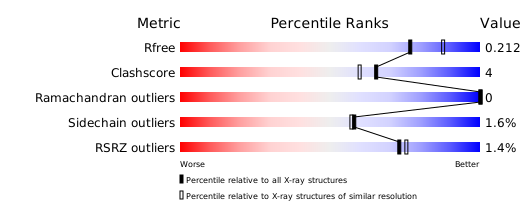
Download full validation report


