






 9TA5
9TA5Summary for 9TA5
| Entry DOI | 10.2210/pdb9ta5/pdb |
| Related PRD ID | PRD_002597 |
| Descriptor | Phosphatidylinositol transfer protein alpha isoform, Microcolin H, IMIDAZOLE, ... (5 entities in total) |
| Functional Keywords | pitp, microcolin h, lipid transport |
| Biological source | Homo sapiens (human) More |
| Total number of polymer chains | 2 |
| Total formula weight | 32805.16 |
| Authors | Eisenreichova, A.,Klima, M.,Boura, E. (deposition date: 2025-11-18, release date: 2026-02-04, Last modification date: 2026-03-11) |
| Primary citation | Eisenreichova, A.,Klima, M.,Balla, T.,Boura, E. Phosphatidylinositol transfer protein alpha binds microcolins in its open conformation. Acta Crystallogr D Struct Biol, 82:246-252, 2026 Cited by PubMed Abstract: Phosphatidylinositol transfer proteins (PITPs) are essential lipid-binding proteins that regulate phosphoinositide signaling, membrane trafficking and autophagy through the transport of phosphatidylinositol and other phospholipids between intracellular membranes. Microcolin compounds have been identified as selective inhibitors of class I PITPs, revealing important roles of PITPs in Hippo signaling and autophagy. Here, we report the crystal structure of human PITPα in complex with microcolin H at 2.0 Å resolution. The structure enables a detailed description of the interaction between microcolin H and the lipid-binding cavity. Besides the expected covalent bond to the Cys94 residue, the structure also reveals an extensive network of hydrogen bonds, water bridges and hydrophobic interactions. Importantly, PITPα remains in the open conformation upon binding to microcolin H. Quantitative cavity analysis confirms that the microcolin-bound structure adopts a volume comparable to that of the unliganded PITPα and is markedly larger than that of the lipid-bound state. These findings demonstrate that microcolins selectively trap PITPα in an open conformation and provide a structural basis for their inhibitory mechanism. Furthermore, our results show that ligand binding can profoundly change protein conformation, which underscores the limitation of docking experiments. PubMed: 41700428DOI: 10.1107/S2059798326000872 PDB entries with the same primary citation |
| Experimental method | X-RAY DIFFRACTION (2.1 Å) |
Structure validation
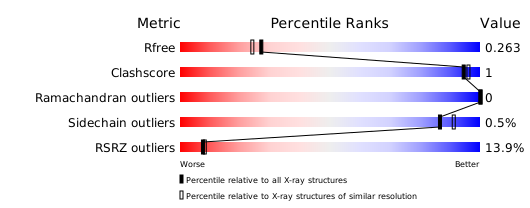
Download full validation report


