






 9T9M
9T9M
Tilvestamab Fab bound to the anti-Fab nanobody
Summary for 9T9M
| Entry DOI | 10.2210/pdb9t9m/pdb |
| EMDB information | 55722 |
| Descriptor | Light chain of BGB149 antibody, Anti Nab-Fab nanobody, Heavy chain of BGB149 antibody (3 entities in total) |
| Functional Keywords | anti-axl, monoclonal antibody, cancer, axl is a receptor tyrosine kinase, antitumor protein |
| Biological source | Mus sp. More |
| Total number of polymer chains | 3 |
| Total formula weight | 60794.51 |
| Authors | |
| Primary citation | Christakou, E.,Lopez, A.J.,Muruganandam, G.,Micklem, D.,Lorens, J.B.,Kursula, P. Structural Analysis of Tilvestamab in Complex with AXL. Acs Omega, 11:1874-1882, 2026 Cited by PubMed Abstract: AXL is a receptor tyrosine kinase with a significant role in various biological processes and important medical implications, particularly in cancer. AXL transduces signals from the extracellular environment into the cytoplasm by binding to its ligand, growth arrest-specific protein 6 (GAS6). Activation of AXL leads to autophosphorylation of its intracellular domain and subsequent activation of downstream signaling pathways involved in cell proliferation, migration, differentiation, and survival. Tilvestamab (also known as BGB149) is a first-in-class, humanized, therapeutic anti-AXL function-blocking monoclonal antibody. We carried out a structural characterization of the AXL-tilvestamab complex using both negative-stain and cryogenic transmission electron microscopy as well as synchrotron small-angle X-ray scattering. While AXL-Fc was highly elongated and formed large heterogeneous complexes with the full antibody, homogeneous samples for structural studies could be made using the monomeric soluble AXL extracellular domain, the Fab fragment of tilvestamab, and an anti-Fab nanobody. Both SAXS and cryo-EM confirmed successful complex formation between the three proteins, and a low-resolution 3D model for the tilvestamab-AXL complex is presented. The data allow for sample optimization for high-resolution structural biology, as well as designing mutations that could alter binding affinity and specificity. PubMed: 41552498DOI: 10.1021/acsomega.5c10003 PDB entries with the same primary citation |
| Experimental method | ELECTRON MICROSCOPY (3.09 Å) |
Structure validation
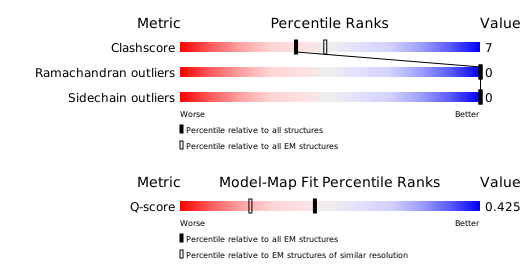
Download full validation report


