






 9SSF
9SSF
PENICILLIN-BINDING PROTEIN 1B (PBP-1B) in complex with Methicillin - Streptococcus pneumoniae R6
Summary for 9SSF
| Entry DOI | 10.2210/pdb9ssf/pdb |
| Related | 9SSD 9SSE 9SSG 9SSH 9SSI |
| Descriptor | Penicillin-binding protein 1B, (2R,4S)-2-[(1R)-1-{[(2,6-dimethoxyphenyl)carbonyl]amino}-2-oxoethyl]-5,5-dimethyl-1,3-thiazolidine-4-carboxylic acid, CHLORIDE ION, ... (4 entities in total) |
| Functional Keywords | cell wall, peptidoglycan synthesis enzyme, infection, drug-binding protein, antibiotics, transferase |
| Biological source | Streptococcus pneumoniae R6 |
| Total number of polymer chains | 1 |
| Total formula weight | 55319.18 |
| Authors | Flanders, P.L.,Gillingham, J.R.,Contreras-Martel, C.,Dessen, A.,Carlson, E.E.,Ambrose, E.A. (deposition date: 2025-09-25, release date: 2026-02-18, Last modification date: 2026-04-01) |
| Primary citation | Flanders, P.L.,Gillingham, J.R.,Contreras-Martel, C.,Dessen, A.,Carlson, E.E.,Ambrose, E.A. Structural and Dynamics Analyses of beta-Lactam Inhibition of Streptococcus pneumoniae Penicillin-Binding Protein 1b (PBP1b) Guide Interrogation of Structure-Activity Relationships. Acs Chem.Biol., 21:490-501, 2026 Cited by PubMed Abstract: The Gram-positive pathogen , like the majority of bacteria, contains a peptidoglycan-based cell wall whose structure is highly dependent on the action of penicillin-binding proteins (PBPs). While the β-lactam antibiotics have been employed as an antimicrobial strategy for nearly a century, much remains unclear about how inhibitor structure informs potency and PBP isoform selectivity. Here, we obtained high-resolution structures (<2Å) of PBP1b cocrystallized with 6 β-lactams. Surprisingly, 2 structures feature a noncanonical conformation of the covalent "acyl-enzyme complex." To clarify how protein-ligand interactions mediate inhibitor binding, we applied molecular modeling and molecular mechanics-based dynamics analyses. Our analyses illustrate how seemingly minimal changes to inhibitor structure modulate β-lactam binding mode and inhibitor potency, as described by the metric /. Furthermore, we demonstrate that persistent interaction in the covalent acyl-enzyme complex between the inhibitor carboxylate and a highly conserved three-residue motif is not fully predictive of / for PBP1b. modeling suggests that the noncovalent preacyl complex may leverage this interaction, but a postacylation change in ligand conformation may accompany acylation in some inhibitors. The elucidation of key PBP1b ligand-receptor interactions pre- and postacylation will inform the rational design of novel PBP inhibitors and probes. PubMed: 41589753DOI: 10.1021/acschembio.5c00788 PDB entries with the same primary citation |
| Experimental method | X-RAY DIFFRACTION (1.931 Å) |
Structure validation
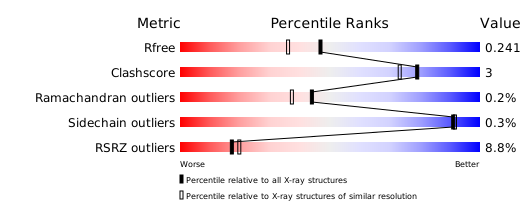
Download full validation report


