






 9SPP
9SPP
p53 cancer mutant Y234C in complex with DARPin C10
Summary for 9SPP
| Entry DOI | 10.2210/pdb9spp/pdb |
| Descriptor | Cellular tumor antigen p53, DARPin C10, 1,2-ETHANEDIOL, ... (5 entities in total) |
| Functional Keywords | p53, tumor suppressor, cancer mutation, protein stability, protein unfolding disease, designed ankyrin repeat proteins, thermostabilization, mutant p53 reactivation, cancer therapy, transcription |
| Biological source | Homo sapiens (human) More |
| Total number of polymer chains | 2 |
| Total formula weight | 36750.97 |
| Authors | Balourdas, D.I.,Muenick, P.,Knapp, S.,Dotsch, V.,Joerger, A.C.,Structural Genomics Consortium (SGC) (deposition date: 2025-09-17, release date: 2026-04-22, Last modification date: 2026-09-30) |
| Primary citation | Munick, P.,Balourdas, D.I.,Funk, J.S.,Yuksel, B.,Mavridi, D.,Heftel, J.,Dreier, B.,Schaefer, J.V.,Schafer, B.,Knapp, S.,Telatar, T.,Akgul, B.,Pluckthun, A.,Stiewe, T.,Joerger, A.C.,Dotsch, V. DARPins as pan-reactivators of temperature-sensitive p53 cancer mutants. Proc.Natl.Acad.Sci.USA, 123:e2531747123-e2531747123, 2026 Cited by PubMed Abstract: The tumor suppressor p53 is the most frequently mutated protein in tumors and a target for drug development. More than 2000 cancer-associated p53 missense mutations have been reported, most of them located in the DNA-binding domain (DBD). Due to the low intrinsic thermostability of the latter, they often lead to unfolding at physiological temperature. Stabilizing the DBD with small molecules has been shown to be effective in reactivating the cavity-creating cancer mutant Y220C. Unfortunately, the majority of p53 mutants seem to lack druggable binding pockets for small molecules. Here we show that a designed ankyrin repeat protein (DARPin) that binds to the p53 DBD stabilizes temperature-sensitive (TS) p53 cancer mutants, thereby compensating for mutation-induced loss of stability. We determined high-resolution crystal structures of multiple DARPin-mutant p53 complexes, providing mechanistic insights into this mode of stabilization. Reporter gene assays across a comprehensive panel of cancer-associated mutants revealed reactivation of the majority of TS mutants, whereas DNA-contact mutants and those with local misfolding of the DNA-binding surface remained inactive, as expected. We demonstrate that this reactivation induces the transcription of canonical p53 target genes and elicits antiproliferative effects in cancer cell lines. A combination of this DARPin with an mRNA/lipid nanoparticle-based transfection approach may have the potential to reactivate most TS p53 mutants and resensitize cancer cells to chemotherapy. PubMed: 42048463DOI: 10.1073/pnas.2531747123 PDB entries with the same primary citation |
| Experimental method | X-RAY DIFFRACTION (1.47 Å) |
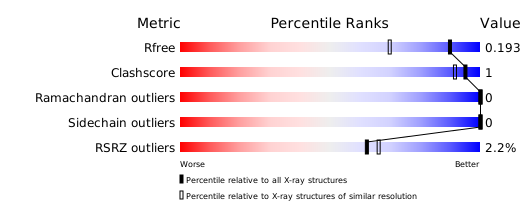
Structure validation
Download full validation report


