






 9SPA
9SPA
Apo ACE2 extracellular domain
Summary for 9SPA
| Entry DOI | 10.2210/pdb9spa/pdb |
| Descriptor | Processed angiotensin-converting enzyme 2, MALONIC ACID, ZINC ION, ... (4 entities in total) |
| Functional Keywords | hydrolase |
| Biological source | Homo sapiens (human) |
| Total number of polymer chains | 1 |
| Total formula weight | 70756.66 |
| Authors | Brear, P.,Hyvonen, M. (deposition date: 2025-09-16, release date: 2026-04-08, Last modification date: 2026-04-22) |
| Primary citation | Romanyuk, Z.,Bettin, G.,Brear, P.,Linciano, S.,Mazzocato, Y.,Bonadies, S.,Zanotto, I.,Mazzucco, C.,Monferone, A.,Soler, M.A.,Pasut, G.,Martin, S.,Scarso, A.,Heinis, C.,Rothenberger, S.,Hyvonen, M.,Angelini, A. Yeast Display Technology Enables Rapid Discovery of Low-Nanomolar Macrocyclic Peptide Inhibitors of Human Angiotensin-Converting Enzyme 2. J.Med.Chem., 69:7689-7708, 2026 Cited by PubMed Abstract: Macrocyclic peptides (MPs) are valuable molecular formats for drug development, bridging small molecules and larger biologics due to their favorable pharmacological properties. Here, we describe the discovery of low-nanomolar inhibitors of human angiotensin-converting enzyme 2 (hACE2) by quantitatively screening millions of structurally diverse disulfide-cyclized peptide ligands using yeast display technology. The most potent yeast-encoded "one-ring" and "two-ring" MP inhibit hACE2 with values of 1.9 and 1.5 nM, respectively. These inhibitory potencies are comparable to those of other cyclic peptides discovered using well-established display technologies. Crystal structures of the two MPs in complex with hACE2 reveal the adoption of either a rigid β-hairpin or a cysteine-stabilized α-helix/α-helix motif. Both MPs exhibit binding modes distinct from those of previously reported inhibitors. Thus, yeast display is a valid technology to rapidly generate MPs with desired binding properties for the development of potential therapeutics. PubMed: 41875055DOI: 10.1021/acs.jmedchem.5c02876 PDB entries with the same primary citation |
| Experimental method | X-RAY DIFFRACTION (1.79 Å) |
Structure validation
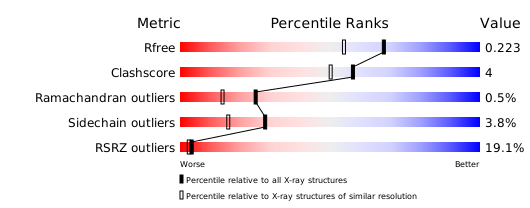
Download full validation report


