






 9SD1
9SD1
The R62Q clinical variant of human bisphosphoglycerate mutase (hBPGM).
Summary for 9SD1
| Entry DOI | 10.2210/pdb9sd1/pdb |
| Related | 9SC0 9SCV 9SCX 9SCY |
| Descriptor | Bisphosphoglycerate mutase, DI(HYDROXYETHYL)ETHER, 1,2-ETHANEDIOL, ... (4 entities in total) |
| Functional Keywords | human bisphosphoglycerate mutase (hbpgm)., isomerase |
| Biological source | Homo sapiens (human) |
| Total number of polymer chains | 4 |
| Total formula weight | 124525.42 |
| Authors | |
| Primary citation | Martinez-Rodriguez, S.,Torres, J.M.,Sanchez, P.,Ortega, E.,Gavira, J.A. New human bisphosphoglycerate mutase structures provide insights into the structural basis of BPGM deficiency and citrate inhibition. Int.J.Biol.Macromol., 338:149491-149491, 2026 Cited by PubMed Abstract: Erythrocyte bisphosphoglycerate mutase (BPGM) plays a major role in regulating hemoglobin (Hb) oxygen affinity by controlling levels of its allosteric effector 2,3-bisphosphoglycerate (2,3-BPG). Besides its well-documented function in glycolysis, BPGM has been proposed as a regulator of serine pathway flux via 3-phosphoglycerate and as an antimalarial target. In humans, BPGM malfunction reduces intracellular concentrations of 2,3-BPG, producing a leftward shift in the hemoglobin‑oxygen dissociation curve. This shift enhances the affinity of hemoglobin for oxygen, thereby impairing oxygen release to peripheral tissues. The resulting tissue hypoxia induces a compensatory erythropoietic response that clinically manifests as polycythemia/ erythrocytosis, characteristic of familial erythrocytosis type 8 (ECYT8). BPGM deficiency is rare, and a comprehensive study has been conducted in only a few patients with this disease, revealing different missense mutations. In the present study, we structurally characterized clinical variants of human BPGM (hBPGM), i.e., Arg62Gln, Arg90Cys, Arg90His, and Gln102Lys, in order to explore the molecular basis of this rare disease. Analysis of the four structural models and of a new citrate-bound hBPGM structure yielded a partial description of further open/closed conformational changes associated with enzyme activity. PubMed: 41354380DOI: 10.1016/j.ijbiomac.2025.149491 PDB entries with the same primary citation |
| Experimental method | X-RAY DIFFRACTION (2.5 Å) |
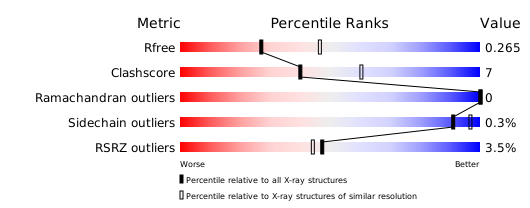
Structure validation
Download full validation report


